
Alicante in 1 Day: The Essence of the City
If you only have one day, it is worth focusing on the heart of Alicante.
Start early in the old town. The Santa Cruz neighbourhood climbs the slopes of Mount Benacantil through whitewashed façades, flowerpots, stairways and narrow streets where, for a moment, the city seems to retreat from the traffic below.
From here, the main attraction is Santa Bárbara Castle.
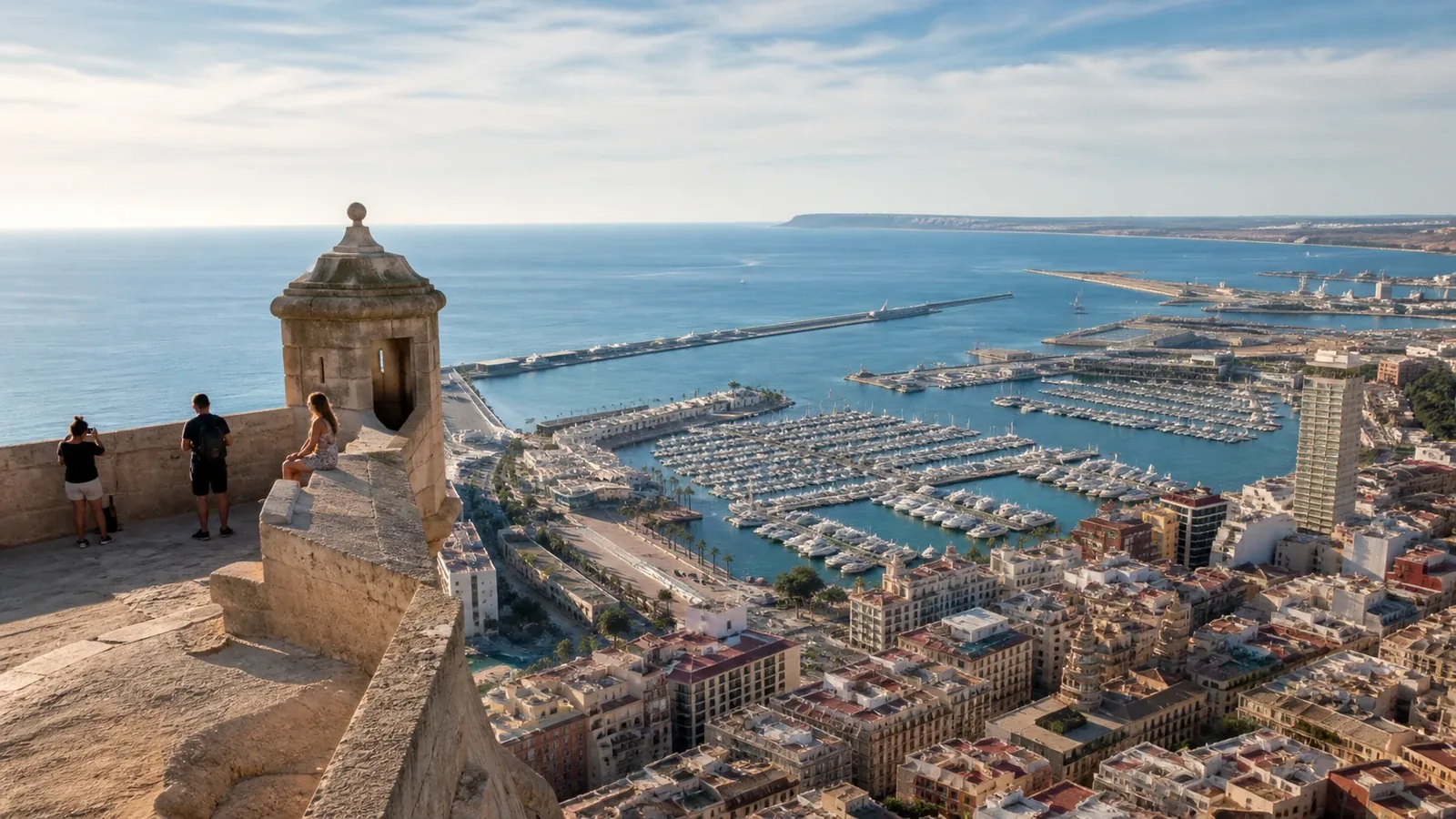
The views help you understand Alicante better than any map could: the harbour, the urban landscape, Postiguet Beach and the Mediterranean unfold beneath the fortress. If you visit during the hottest months, it is best to avoid the middle of the day for uphill walks and other routes exposed to the sun.
Back in the centre, take some time to explore the historic streets and some of the squares that shape the old quarter.
For lunch, Alicante deserves more than simply choosing the first terrace with pictures of paella on the menu. Local cuisine has deep ties to rice, fish and Mediterranean produce. If there is a particular rice dish you want to try, bear in mind that specialities and preparation methods vary from one restaurant to another.
After lunch, head down to the Explanada de España, one of the city’s most recognisable promenades. Palm trees, terraces, the activity around the harbour and the wave-patterned mosaic paving create the classic image of Alicante that many travellers come looking for.
Finish the afternoon on Postiguet Beach. It is not necessarily the quietest beach in the province, especially in high season, but few cities make it so easy to move from historic centre to castle to a swim in the Mediterranean.
A logical one-day route: old town → Santa Cruz → Santa Bárbara Castle → city centre → Explanada → Postiguet.
Alicante in 2 Days: Add the Sea and Neighbourhoods with a Different Character
With a second day, you can already slow the pace.
Keep the first day for the historic centre, the castle and the seafront. On the second, a good option is to explore Cabo de las Huertas and Playa de San Juan.
Playa de San Juan offers a different experience from Postiguet. There is a greater sense of space, and the surroundings become more residential.
Around Cabo de las Huertas, you can discover a rockier coastline, with small coves and a less urban feel than the city centre.
It is worth keeping expectations realistic, however: Alicante and its coastline can become very busy in summer, and searching for complete solitude in the best-known spots during peak season is usually a recipe for disappointment.
Alicante in 3 Days: The Most Balanced Break
For many travellers, three days is an especially comfortable amount of time.
Day 1: Historic Alicante. Spend the day exploring Santa Bárbara Castle, Santa Cruz, the old town and the squares in the city centre.
Take it slowly. Part of Alicante’s appeal lies precisely in wandering without an endless list of sights to tick off.
Day 2: Mediterranean Alicante. Set aside the second day for the harbour, the Explanada and the coastline. You can combine Postiguet with other seaside areas and end the afternoon watching the light change over the Mediterranean.
Day 3: Tabarca or a More Relaxed Day. One of the best-known excursions from Alicante is Tabarca, a small island off the Alicante coast.
When the sea is calm, it can make for a wonderful day trip: narrow streets, maritime scenery and the unmistakable feeling that you have left the city behind. But the experience varies greatly depending on the time of year. During the busiest periods, it loses some of the serenity suggested by certain photographs.
If boat trips do not appeal to you, spend your third day getting to know Alicante at a slower pace. Markets, museums, neighbourhoods, food and a long afternoon by the sea may prove more satisfying than adding another excursion simply for the sake of it.
Alicante in a Week: Use the City as a Base
Spending an entire week solely in central Alicante may feel too long for travellers who like to visit several monuments every day.
But spending a week based in Alicante is a very different proposition.
The city allows you to alternate urban days, beach time and trips around the province.
A sensible itinerary could look like this:
Day 1: historic centre, Santa Cruz and Santa Bárbara Castle.
Day 2: Explanada, harbour, Postiguet and city life.
Day 3: Playa de San Juan and Cabo de las Huertas.
Day 4: day trip to Tabarca.
Day 5: excursion to a coastal town elsewhere in the province.
Day 6: inland landscapes, nature or villages, depending on your interests.
Day 7: Alicante with no agenda: market, food, shopping, beach or anything you would like to revisit.
The mistake would be to fill all seven days with long journeys. A Mediterranean week also needs a morning without an alarm clock and at least one lunch that lasts longer than expected.
What Is the Best Route Through Alicante?
For a first visit, the most natural sequence is to begin in the historic heart of the city and finish by the sea.
Benacantil and the castle → Santa Cruz → old town → city centre → Explanada → harbour → Postiguet.
This route avoids unnecessary backtracking and lets you understand the city in a fairly intuitive way: first Alicante from above, then Alicante on foot, and finally Alicante facing the Mediterranean.
What Should You Combine with Alicante?
If you have several days, the rest of the province opens up many more possibilities.
Elche is particularly appealing to travellers interested in heritage and an urban landscape shaped by palm trees. Villajoyosa offers colourful façades and a strong maritime tradition. Farther away, towns such as Altea reveal another side of the Costa Blanca, although it is worth considering travel times before trying to squeeze too many destinations into a single day.
The best combination depends less on collecting famous place names and more on the kind of trip you want.
If you are looking for the sea, prioritise the coast and the island. If heritage interests you more, make time for Alicante and Elche. If your main aim is to relax, it may be better to visit fewer places and spend more time enjoying the beaches.
Do You Need a Car for This Itinerary?
You do not need a car to explore central Alicante. In fact, it can become more of an inconvenience if your accommodation is centrally located and your plans mainly involve visiting the city’s key sights.
For exploring the province more extensively, a car gives you greater freedom, particularly if you want to reach coves, small villages or natural areas with limited public transport.
That does not mean a car is essential for every excursion. The decision should depend on the specific routes you want to take, rather than on the assumption that a Costa Blanca holiday automatically requires a rental car.
Mistakes That Can Ruin an Alicante Itinerary
One of the most common is trying to see everything at midday in the height of summer. Mediterranean light can be spectacular, but the heat completely changes how demanding a walk can feel.
Another mistake is reducing Alicante to Postiguet, the Explanada and a photograph of the castle. That combination shows the city’s most obvious face, but leaves much of its personality unexplored.
It is also worth avoiding the opposite extreme: scheduling every hour. Alicante works particularly well when there is time left to sit on a terrace, wander into a market, turn down a street that looks interesting or linger by the sea for longer than planned.
How Many Days Does Alicante Really Deserve?
One day is enough to see the main landmarks, but you will have to be selective.
Two days make for a fairly complete city break.
Three days allow you to combine heritage, city life and the Mediterranean at a much more enjoyable pace.
A week makes particular sense if Alicante will serve as your base for exploring different parts of the province while alternating excursions with days of rest.
Alicante may not need a full week to reveal its main monuments. What it needs is something different: enough time to understand its rhythm.
Because beyond the castle, the palm trees and the deep blue of the sea, there is another, more everyday Alicante. A city of morning markets, long lunches, neighbourhoods looking towards Benacantil and afternoons when the Mediterranean seems to become part of the street itself.
And that Alicante usually appears precisely when we stop trying to see everything.
