

Benidorm in spring: probably the best balance
Spring gradually brings Benidorm’s summer atmosphere back to life without taking it to extremes.
The days grow longer, outdoor terraces come back into their own, and walking along Levante, Poniente or through the old town is usually more pleasant than under the intense summer sun.
It is an especially good time for travellers who want to combine the beach with outdoor activities. Serra Gelada, the viewpoints and nearby towns are much easier to enjoy when walking for several hours does not mean dealing with August heat.
The drawback is obvious: if your main goal is to swim for hours and experience a fully summery atmosphere, early spring may fall short. The Mediterranean can still feel cool, and the weather is not as consistently settled as it is in summer.
Is it worth travelling in May or June?
Yes, especially if you want to avoid the extremes.
June offers many of the advantages of summer, while May still feels somewhat quieter. As July approaches, both the atmosphere and the number of visitors increase.
For couples, active travellers and anyone who wants to see more than just the beach, this period is particularly attractive.
Benidorm in summer: sun, beach and plenty of people
In July and August, Benidorm becomes the place most people picture: rows of parasols facing the Mediterranean, packed terraces, families heading to the beach and nights that seem to extend the day.
It is the right time if you are looking for heat, frequent swims, water activities and a lively atmosphere.
It is also when some of the destination’s less appealing characteristics become more noticeable. Popular areas can be very crowded, peace and quiet are harder to find, and accommodation is usually under heavy demand.
Benidorm has enough infrastructure to welcome large numbers of visitors, but that does not mean everyone will enjoy the crowds.
July or August?
Both months offer a distinctly summery experience. August usually coincides with one of the busiest holiday periods, so travellers with some flexibility may find June or September more balanced.
If August is the only time you can travel, that does not mean you should rule it out. It is simply worth knowing what kind of Benidorm you are likely to find and planning your days with a little more patience.
September: one of the most appealing months
September has a special quality on the Mediterranean coast. Summer is still in the air, but little by little it begins to lose its intensity.
The sea retains the warmth accumulated over the previous months and, as September progresses, the destination can feel less hectic.
For anyone who wants a beach holiday without necessarily seeking the height of the summer buzz, September is a very attractive option.
That said, travelling outside July and August never guarantees empty beaches. Benidorm is a well-established tourist destination for much of the year and remains lively beyond the summer season.
Benidorm in autumn: another way to experience the city
In autumn, the experience begins to change.
Daylight hours decrease and unsettled weather becomes more likely, but it also becomes easier to discover a side of Benidorm that is not defined solely by the beach.
It is a good time to walk through the old town, sit by the Mediterranean without rushing, stroll along Poniente or devote part of your trip to exploring the surrounding area.
October can still bring very pleasant days, although it is no longer wise to plan a holiday on the assumption that every day will be suitable for the beach.
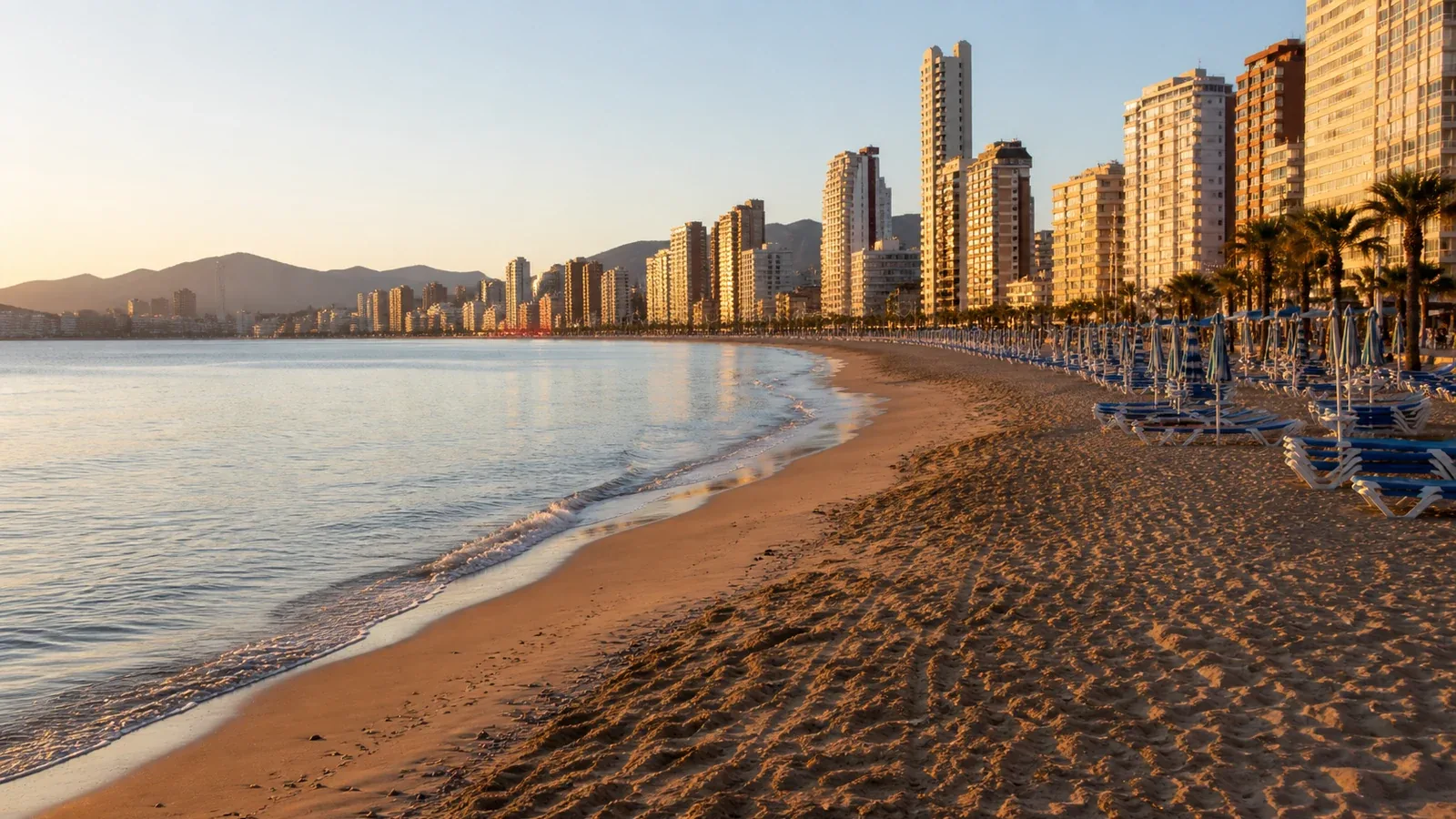
Benidorm in winter: is it worth it?
Yes, but only if you understand that it is a different kind of trip.
Benidorm has one major advantage over coastal destinations that practically shut down outside the summer season: it remains lively in winter.
The scenery changes. The beaches offer more room for walking, mornings invite you to explore the seafront promenade, and the low winter sun lights up the buildings with a different clarity from summer.
For travellers coming from European regions with harsher winters, that relatively mild climate may be the attraction in itself.
But it would be misleading to present winter as a milder version of summer. There can be cool days, wind and periods of rain. Daylight hours are shorter, and anyone travelling solely in search of intense heat and long swims should probably choose another season.
When are there fewer tourists in Benidorm?
In general, it is easier to find a less crowded city outside the main holiday periods and the summer season.
Winter can offer a much quieter experience, while spring and autumn provide a middle ground between atmosphere and comfort.
Even so, Benidorm is not a small seaside town that shuts down after September. Its tourist season is long, and certain events, holidays and weekends can significantly increase visitor numbers.
When is it cheaper to travel to Benidorm?
Travelling outside the periods of highest demand will usually give you better accommodation options than during the peak weeks of summer.
However, there is no single month that is always cheap. Prices depend on the exact dates, how far in advance you book, events, the type of accommodation and overall demand.
If budget matters, it is usually smarter to compare dates in spring, autumn and winter than to assume there is one fixed period when Benidorm is always inexpensive.
Events and atmosphere: the calendar matters too
Benidorm has a busy programme of celebrations and events that can temporarily transform the atmosphere of the city.
This can be either an advantage or a drawback. For some travellers, finding lively festivities and animated streets adds character to the trip. For others, it means more noise, higher occupancy and greater difficulty enjoying a peaceful stay.
If you already have specific dates in mind, it is worth checking the official events calendar before booking, especially if peace and quiet or budget are priorities.
Which time of year should you choose for your type of trip?
For beach and heat: July and August offer the clearest summer experience, in exchange for larger crowds.
For combining beach time and sightseeing: late spring and September usually offer a particularly attractive balance.
For couples: May, June, September and October can be more enjoyable if the idea is to walk, eat at a relaxed pace and enjoy the sea without making the beach the sole focus of the trip.
For families with children: summer makes the classic beach holiday easier, although you should expect heat and crowds.
For hiking and excursions: spring, autumn and pleasant winter days are more comfortable than the hottest weeks of the year.
For peace and quiet: winter and certain low-season periods reveal a very different side of Benidorm.
So, what really is the best time to visit?
If you had to choose a period for overall balance, late spring and September would be especially strong candidates.
There is enough daylight and atmosphere to enjoy Benidorm’s Mediterranean character, while some of the drawbacks associated with the height of summer are reduced.
However, choosing the right season means accepting that each one involves some compromise.
Summer offers Benidorm at its most vibrant, but also at its most intense. Winter brings peace and quiet, but does not guarantee a beach holiday. Spring and autumn offer the middle ground, although the weather can be less predictable.
And perhaps that is the key: there is no single best time to visit Benidorm; there is a time of year that fits the way you want to travel. An approach focused on genuinely answering the reader’s intent, with clear, useful and well-organised content, also aligns with Google’s SEO best practices for people-first content.
