

Book a barista course in Berlin to learn espresso and latte art in a small group with ECM and Ascaso machines, coffee, milk and course materials included.
View experienceWhere to eat in Berlin: what people really eat in the city
Berlin’s most recognizable food is not usually found on white tablecloths. Currywurst, döner kebab, falafel, Buletten, and Pfannkuchen are part of that everyday map of quick, popular, hybrid flavors that explain the city better than many museums. Berlin does have a simple local cuisine, shaped by pork dishes, schnitzel, pork knuckle, and homestyle German recipes, but its current culinary identity is much broader: Turkish, Vietnamese, Syrian, Lebanese, Korean, vegan, experimental, and market-driven.
Currywurst in Berlin: an icon, yes; a culinary miracle, no
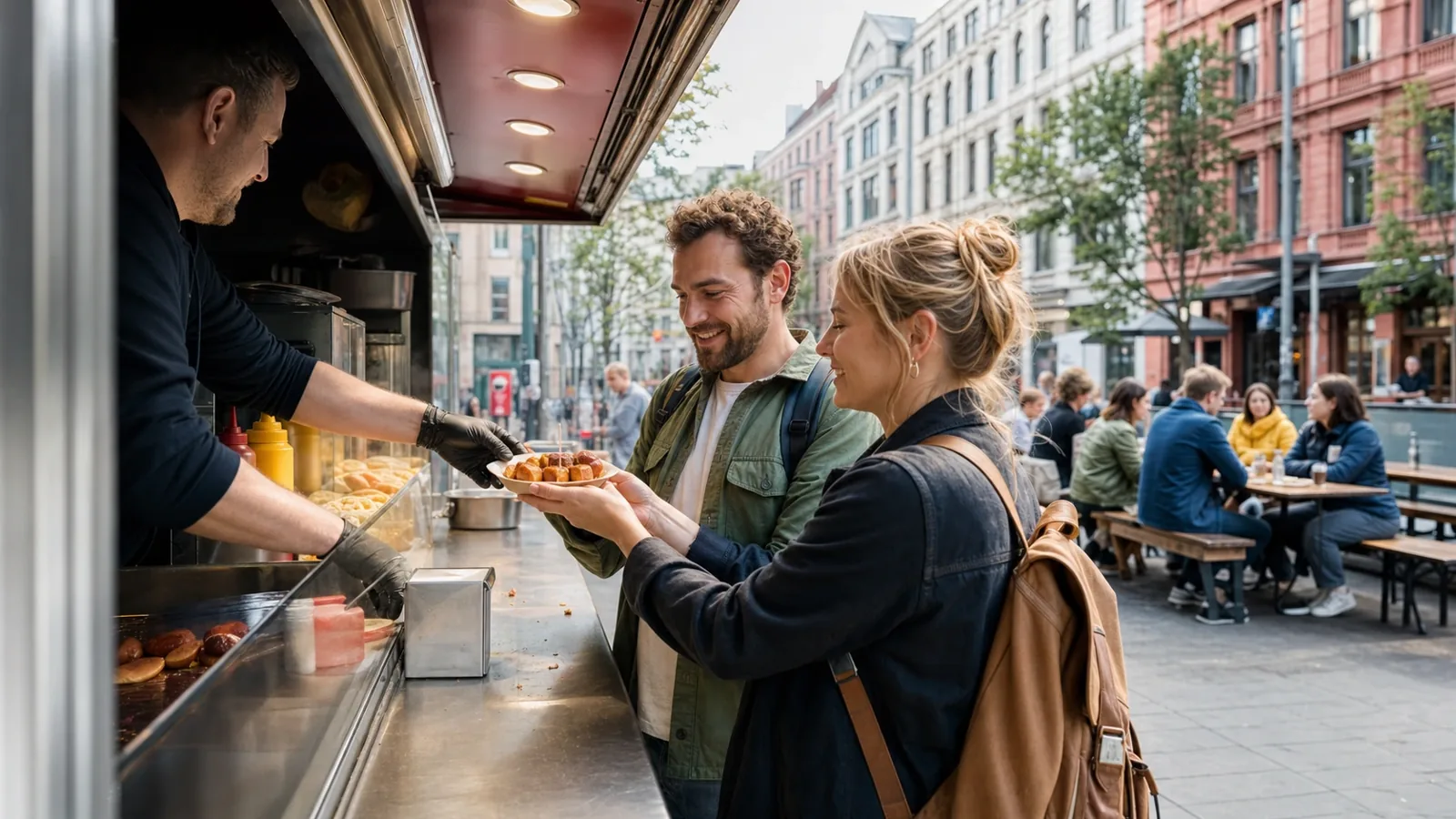
Currywurst in Berlin is worth trying once, especially if you want to understand the city at its most popular: sausage, spiced tomato sauce, curry powder, and fries. It is straightforward, greasy, photogenic in its own way, and very Berlin. But it is worth being honest: not every traveler will find it exciting. For some, it will be a nostalgic and fun bite; for others, simply a sausage with sauce.
Classic stands such as Curry 36 or Konnopke’s Imbiss appear on many food routes, but there is no need to turn the search for “the best currywurst” into a sacred pilgrimage. Sometimes the best experience is simply eating it standing up, with cold hands, after walking too far.
There is no need to obsess over the best currywurst: sometimes the ritual matters more than the stand.
Döner, falafel, and Turkish food: Berlin’s most everyday flavor
The Berlin döner is an urban institution. It is not just fast food: it is a late-night dinner, a student meal, a lifesaver after a museum visit that went on too long, and a symbol of the city’s Turkish-German history. VisitBerlin includes it alongside currywurst as part of Berlin’s street food culture, and it is no exaggeration to say that many visitors will remember a good döner more vividly than a formal dinner in Mitte.
For a more authentic experience, it is worth looking toward Kreuzberg, Neukölln, Wedding, or Moabit rather than staying only around the monuments. Imren Grill, Pamfilya, Rüyam, and Mustafa’s Gemüse Kebap are names that often come up in conversations about döner in Berlin, though patience is required: some famous spots mean long lines, and the wait is not always worth it if you are short on time.
Falafel is also an excellent bet, especially for vegetarians. Berlin has a generous Levantine and Middle Eastern food scene, with generous portions, bright flavors, and prices that are usually friendlier than a sit-down meal in tourist areas.
If you are short on time, a long line at a viral spot is not always worth it.
Berlin food markets where you can try several flavors without the fuss
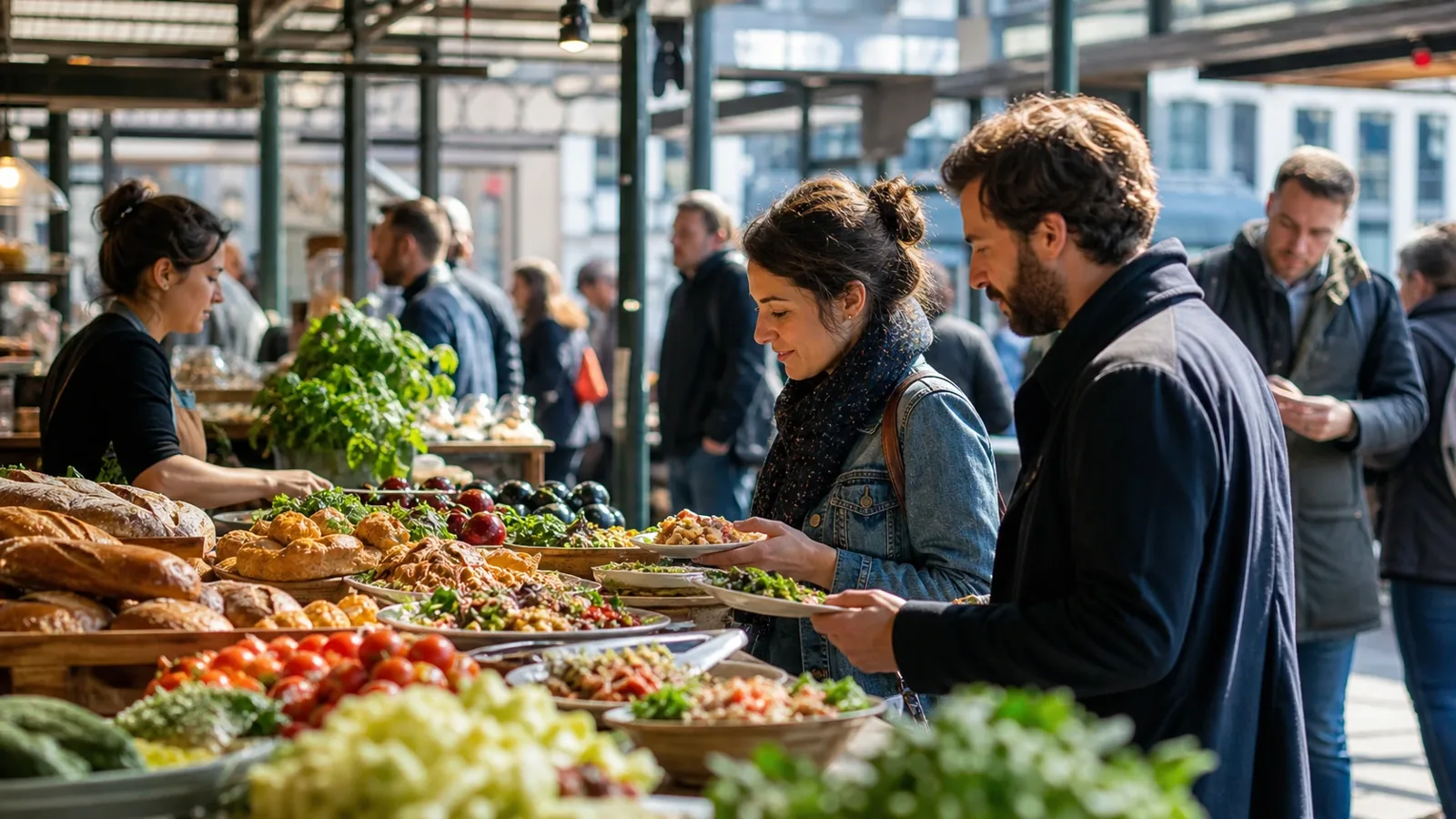
Markthalle Neun, in Kreuzberg, is one of the most interesting Berlin food markets for anyone who wants to try several things in a single visit. Its Street Food Thursday takes place on Thursday evenings, from 5:00 p.m. to 10:00 p.m., bringing together cooks and small projects in a lively, informal, very Berlin atmosphere.
The best thing about it is the variety and energy of the place; the downside is the crowding. If you are looking for calm, slow conversation, and a guaranteed table, this may not be your place. If you are happy to eat standing up, share space, and follow the aromas that shift every few steps, it can become one of the most memorable dinners of the trip.
The Maybachufer market, between Kreuzberg and Neukölln, is ideal for seeing a more everyday Berlin: fruit, bread, cheeses, olives, fabrics, mixed voices, the smell of spices, and simple takeaway food. It takes place on Tuesdays and Fridays from 11:00 a.m. to 6:30 p.m., though it is worth checking the opening times before planning your day around the market.
It is not a “pretty” market in the polished tourist sense; its charm lies precisely in how lively, crowded, and imperfect it is. It may disappoint anyone expecting a gourmet postcard, but it will appeal to those who want to feel the real pulse of a neighborhood.
Check market opening times before planning your day around them.
German restaurants in Berlin: when they are worth it
Eating German food in Berlin makes sense, but you do not need to do it every day. A good traditional restaurant can be comforting, especially in autumn and winter, when the city turns gray and the body asks for beer, soup, cabbage, potatoes, and hearty dishes. VisitBerlin mentions places such as Brauhaus Lemke for traditional German food and house-brewed beer, as well as restaurants like Berliner Republik or Mark Brandenburg for regional flavors and more formal German cuisine.
The warning is clear: many “typical” restaurants near major sights live more off tourist traffic than quality. Before sitting down, look at the menu. If it is translated into too many languages, full of photos, and has an endless list of dishes, you may be better off continuing your walk.
A menu translated into too many languages, full of photos, and endlessly long is usually a sign to keep walking.
Cheap eats in Berlin without eating badly
Berlin is no longer as cheap as many people remember, but it still offers reasonable options if you move away from the most obvious areas. To eat well without spending too much, look for Imbiss and neighborhood stands.
Imbiss — small fast-food spots — are an essential part of the city. Currywurst, döner, falafel, noodles, simple burgers, or Vietnamese dishes can solve a meal without ceremony. The key is to observe: high turnover, visible ingredients, a local line, and a short menu are usually good signs.
Berlin has a very strong Vietnamese food scene. In neighborhoods such as Prenzlauer Berg, Mitte, Friedrichshain, Kreuzberg, and Neukölln, you will find plenty of places serving soups, bowls, rolls, and fresh dishes. Not all are extraordinary, but many offer better value for money than German restaurants aimed at tourists.
For breakfast or a light meal, bakeries are reliable allies: dark bread, pretzels, pastries, simple sandwiches, and coffee. You will not always find the most delicate coffee, but you will find an affordable, local way to start the day.
Vegan and vegetarian Berlin: one of the city’s best sides
Berlin is especially easy for vegetarian and vegan travelers. The city has a creative plant-based scene, from informal spots to vegetarian fine dining. VisitBerlin highlights the growth of Berlin’s green cuisine and mentions projects such as Cookies Cream on the more gastronomic side, as well as vegan options in Neukölln like Alaska.
Here, Berlin shines more than many European capitals: it does not simply “adapt” dishes by removing meat, but in many places cooks from a different logic altogether. Even so, the best-known vegan restaurants can be expensive or packed, so it is wise to book when the place is small or well known.
For small or well-known vegan restaurants, booking ahead is usually wise.
Best neighborhoods to eat in Berlin
Kreuzberg is good for street food, Turkish cuisine, markets, informal bars, and atmospheric dinners. It is a lively area, sometimes noisy, sometimes chaotic, but very rewarding for eating without ceremony.
Neukölln is ideal for young, international, vegan food, cafés with personality, and small restaurants. It can be uneven: alongside very interesting places, you will also find spots that are more about trend than substance.
Prenzlauer Berg is quieter, more family-oriented, and more orderly. A good neighborhood for brunch, cafés, relaxed dinners, and restaurants with a carefully curated atmosphere. It may feel less raw and less spontaneous than Kreuzberg or Neukölln.
Mitte is convenient if you are visiting museums and monuments, but with a higher risk of overpaying for a correct yet soulless experience. There are good restaurants, yes, but you need to choose more carefully.
Charlottenburg is more elegant and classic, with good German, Asian, and fine-dining restaurants. Interesting if you are looking for a slower, less alternative dinner.
Tourist traps worth avoiding when eating in Berlin
The first trap is eating when you are extremely hungry right next to the major tourist sights: Alexanderplatz, Checkpoint Charlie, Unter den Linden, or the busiest areas around the Brandenburg Gate. That does not mean everything is bad, but the chance of paying more for less increases.
The second trap is obsessing over viral places. Berlin has many spots made famous by TikTok, lines, or international lists. Some are worth it; others turn a simple meal into an absurd wait.
The third is thinking that German cuisine defines the whole city. Berlin is better understood by eating between cultures than by searching for a culinary purity that, in truth, has never been its greatest virtue.
What to order at least once
Try a currywurst if you want the popular ritual. Eat a döner or falafel in a neighborhood with real life. Look for Buletten if you are interested in homestyle Berlin cooking. In winter, if your body asks for it, step into a beer hall and order something hearty. And save at least one meal for being surprised by contemporary Berlin: Vietnamese, vegetarian, Syrian, Korean, Georgian, or whatever appears on a side street with good energy.
Who will enjoy eating in Berlin
Berlin is a great city for those who enjoy diverse, informal, multicultural food. It is also ideal for vegetarians, vegans, curious travelers, and people who prefer a table with character over polished perfection.
It may disappoint those looking for a local cuisine as instantly recognizable as Italian, French, or Japanese food. Berlin seduces not through a single refined culinary tradition, but through mixture, contrast, and freedom.
Final advice for eating well in Berlin
You eat better in Berlin when you abandon the idea of “the perfect restaurant” and accept the city as it is: a little rough, creative, changing, generous in flavor, and not particularly interested in pleasing everyone. The best plan will not always be the most famous one, but the one that leaves you sitting — or standing — with something warm in your hands, watching a city pass by that never quite finishes putting itself in order.