

Book a guided tour of Málaga Alcazaba and Roman Theatre in 1.5 hours, with admission included, a professional guide and organized group access.
View experienceThe best way to get around Málaga city
For a first visit, the historic centre is best explored on foot. The Cathedral, the Alcazaba, the Roman Theatre, Calle Larios, the Picasso Museum, the Atarazanas Market and Muelle Uno are all within a reasonably compact area. Here, the car does not bring freedom: it brings expensive parking, restricted streets, traffic and the feeling of fighting the city instead of enjoying it.
Walking also has its rewards. Málaga is a city of low light and white reflections, of bougainvillea spilling over old walls and terraces where time seems to stretch. But it is worth being honest: in summer, walking at midday can be exhausting. Distances are not huge, but the heat multiplies every metre. In July and August, the smart thing is to walk early, rest during the middle of the day and head out again when the sun starts dropping towards the port.
In July and August, avoid planning all your movement on foot during the middle of the day.
Malaga city bus: useful, cheap and practical for the eastern beaches
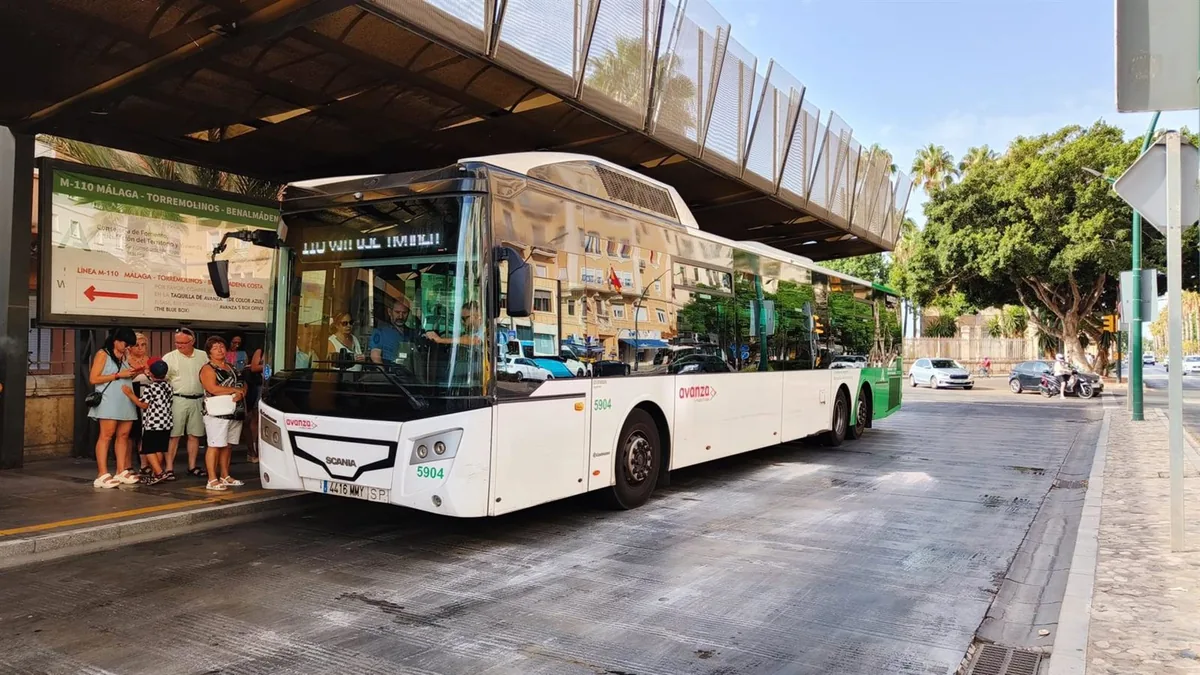
The EMT bus network is practical for reaching neighbourhoods, beaches and areas not served by the metro or train. In 2026, the standard EMT Málaga ticket is listed at €1.40, valid on regular lines except the airport route and special services. The Airport Express line costs €4 and can be paid for on board in cash or by bank card, as well as with a QR ticket in the app.
The Malaga city bus is especially useful for getting to Pedregalejo and El Palo, two seaside districts to the east where the urban beaches have more local character than postcard polish. It also helps if you are staying outside the centre or want to avoid long walks in the heat. The weak point is traffic: at rush hour, on rainy days or during events, journey times can stretch. To get around without stress, it is worth checking timetables and waiting times on the EMT app or website, which shows lines, routes and stops.
For Pedregalejo and El Palo, the bus is usually more comfortable than walking the whole way from the centre.
Málaga Metro: comfortable, but not useful for everything
Málaga’s metro is clean, simple and comfortable, but its usefulness for visitors depends heavily on where you are staying. It is a good option for areas such as El Perchel, María Zambrano station, Teatinos and Andalucía Tech. It is not, however, the main tool for exploring the old town, because much of what visitors most want to see is still best enjoyed on foot.
The metro card fare is listed at €0.49 for the current period indicated by Metro Málaga, with the card itself charged separately, and standard opening hours run from early morning until night, with extended hours on Fridays, the eve of public holidays and Saturdays.
Malaga Cercanias train: the key to the airport and the Costa del Sol
The Malaga Cercanias train is probably the smartest way to connect the city with the airport and several points along the Costa del Sol. Line C1 links Málaga Centro-Alameda with Fuengirola and stops at Málaga-María Zambrano, the airport, Torremolinos and Benalmádena. Aena gives an approximate journey time of 12 minutes between the airport and Málaga city centre, and 8 minutes to María Zambrano, the high-speed train station.
For anyone arriving by plane and staying near the centre, the train is usually the most logical option: fast, simple and not dependent on traffic. Renfe publishes zone-based fares for Cercanías Málaga; a single ticket starts at €1.80 for 1/2 zones, although fares can change and should be checked before travelling.
The Cercanías train is also useful for easy day trips to Torremolinos, Benalmádena or Fuengirola. For Marbella, Estepona, Nerja or many inland villages, it is no longer enough: there you will need an intercity bus, an organised excursion or a car.
For the airport and the city centre, the Cercanías train is usually faster and more reliable than depending on traffic.
Do you need to rent a car in Málaga?
To visit Málaga city, no. To explore the province freely, probably yes.
Renting a car in Malaga is worth it if you want to go to Ronda, Antequera, Frigiliana, Nerja, the Caminito del Rey, white villages or less accessible coves. It is also useful if you are travelling as a family, with heavy luggage, or if you are planning a route through the Axarquía or the Serranía. But renting a car while staying right in the centre can be an expensive mistake: many streets are narrow, parking is not always friendly and some accommodation is in areas where access by car is awkward.
The best strategy is often to split the trip: spend a few days in Málaga without a car, enjoying the centre, museums, port and urban beaches; then rent a vehicle only for the part of the trip that takes you around the province.
Use the car for leaving the city, not for moving around the historic centre.
Practical distances within Málaga
Málaga can be a little deceptive. On the map it looks small, and many areas are, but the heat, the slopes up towards Gibralfaro and the city’s spread to the east and west change the experience. From the centre, La Malagueta is easy to reach on foot. Going up to Gibralfaro Castle, however, requires strong legs, water and the right time of day. Walking from the centre to Pedregalejo is possible for active travellers, but for most people it will be more comfortable to combine a stroll with the bus.
If you are travelling with children, older people or limited time, it is not wise to approach Málaga as an “everything on foot” city in the middle of summer. It is far more enjoyable when you alternate walking with public transport.
Taxis and ride-hailing services in Malaga: comfortable, but not always necessary
Taxis and ride-hailing services make sense for late-night arrivals, luggage, door-to-door transfers or poorly connected accommodation. From the airport, they may be more convenient than the train if there are several of you or if your accommodation is far from Centro-Alameda. Even so, for a solo traveller or a couple staying in the centre, the Cercanías train is usually more efficient.
During major events, Easter Week, the Feria or periods of high occupancy, traffic can greatly affect the experience. At those times, walking or taking the train is usually more reliable than depending on a car.
Bicycle and scooter: pleasant, with caveats
Málaga has some very pleasant areas for cycling, especially along the seafront promenade and in certain flat areas. But not all of the historic centre is equally comfortable: some streets are crowded, surfaces can be uneven and there are spaces where sharing with pedestrians requires patience. For coastal rides, a bicycle can be a delight; for crossing the old town at peak tourist hours, less so.
Common mistakes when getting around Málaga
The first mistake is renting a car from day one if you are only visiting the city. The second is underestimating the heat: a pleasant distance in April can feel heavy in August. The third is staying far from the centre thinking that “everything is close” and then discovering that every outing requires a bus, taxi or long walk. And the fourth is failing to distinguish between Málaga city and the province: getting to Torremolinos by train is easy; reaching certain white villages without a car can be slow and impractical.
So, what is the ideal formula for getting around Malaga?
For a city break, the best plan is to stay near the centre, walk a lot, use the bus for the eastern beaches and take the Cercanías train for the airport or the nearby Costa del Sol. For a broader route around the province, add a car only when you are leaving the city.
Málaga is best enjoyed when you do not force it. Some cities demand speed; Málaga asks for rhythm. Walking when the light falls over the Alcazaba, taking a bus to the neighbourhood beaches, boarding the train to watch the outline of the coast and saving the car for the mountains or inland villages: that is perhaps the most sensible way to move around a city that seems simple, but changes greatly depending on the time of day, the season and the type of trip.
The most practical formula is to walk in the centre, use public transport in the city and save the car for the province.