

3-day Merzouga tour from Marrakech with the Atlas Mountains, Ait Ben Haddou, Erg Chebbi dunes, camel ride, Berber camp night and organised transport.
View experienceArriving Thinking the Marrakech Medina Is a Stage Set
The first mistake is looking at the Marrakech Medina as if it existed only for visitors. It is not an Oriental theme park: it is a living neighborhood, with residents, shops, mosques, workshops, children, motorbikes, donkeys, tourists and an energy that is not always comfortable.
It is best to walk with curiosity, but also with respect. Do not photograph people up close without permission, do not block narrow passageways to take a picture, and do not enter shops as though they were free displays if you have no real interest. The city is more enjoyable when you understand that you are stepping into someone else’s life, not into a postcard.
The Marrakech Medina is more enjoyable when you understand that you are stepping into someone else’s life, not into a postcard.
Not Agreeing on Taxi Prices Before Getting In
In Marrakech, transport can be simple if handled calmly, but it can also become a source of small misunderstandings. You can get around on foot, by taxi, bus, car, bicycle or scooter, although for many travelers taxis remain the most practical option for short rides or airport arrivals.
The important tip is not to assume everything will be clear at the end of the ride. In such a lively city, one question before you get in can save you tension, awkward bargaining and the wrong first impression.
The common mistake is getting into a taxi without agreeing on anything or without asking about the meter when appropriate. Before closing the door, it is best to make the price or payment method clear. There is no need to argue; a firm smile and a direct question are enough. If the answer does not convince you, find another taxi.
Before closing the taxi door in Marrakech, make the price or payment method clear.
Believing That Getting Lost Is Always Romantic
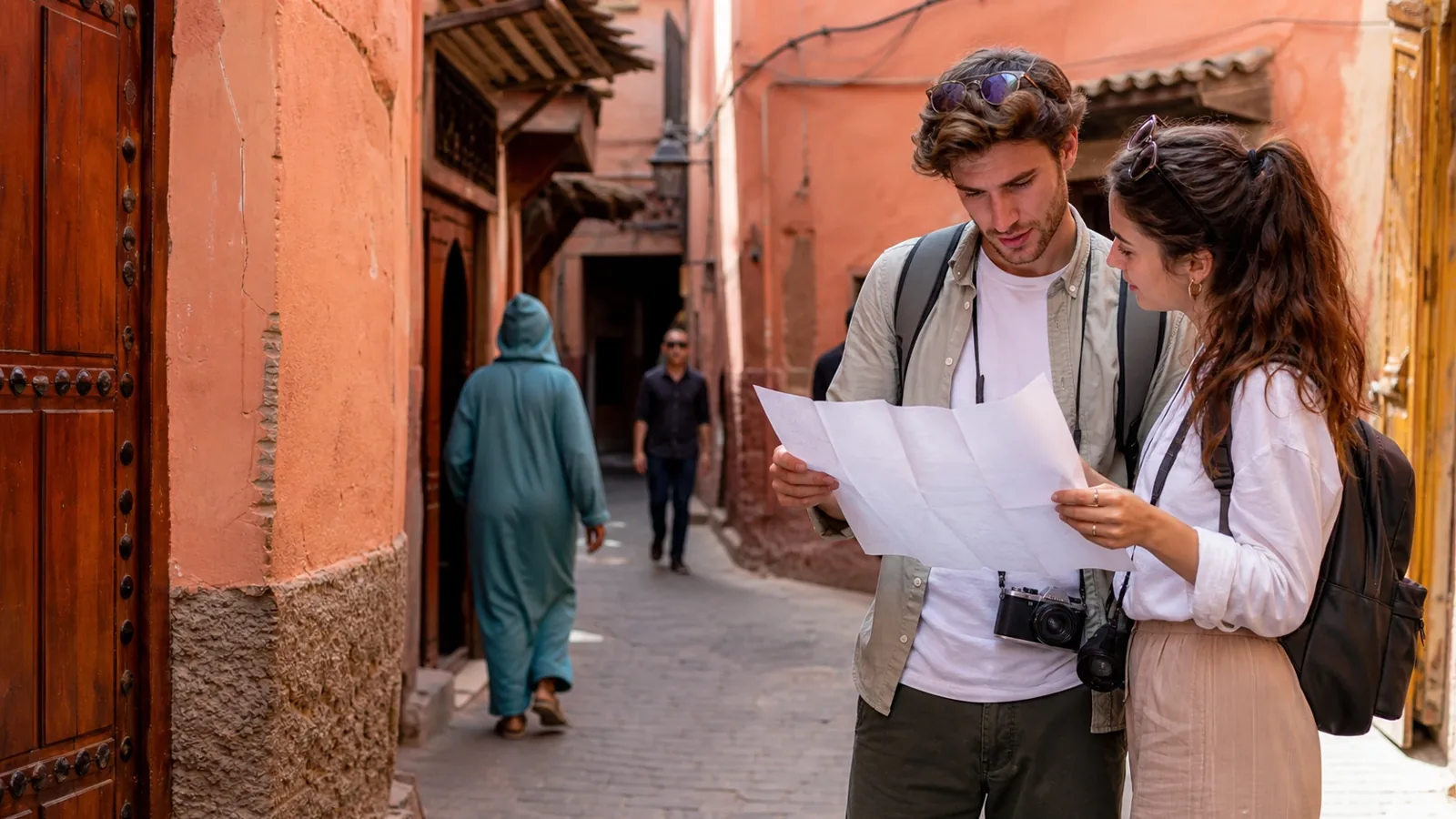
Getting lost in Marrakech can be part of the journey, yes. But getting lost while tired, with luggage, at nightfall or while searching for a riad hidden among streets with no visible names is far less charming.
Book your first accommodation in a good location and ask for clear directions before you arrive. Many riads are inside the Medina, where cars cannot always reach the door. That means walking, sometimes through narrow alleyways. The fantasy of a quiet courtyard with a fountain and tiles can be beautiful, but the arrival can be confusing if it is not well organized.
Book your first accommodation in a good location and ask for clear directions before you arrive.
Bargaining in Marrakech Souks as If It Were a Battle
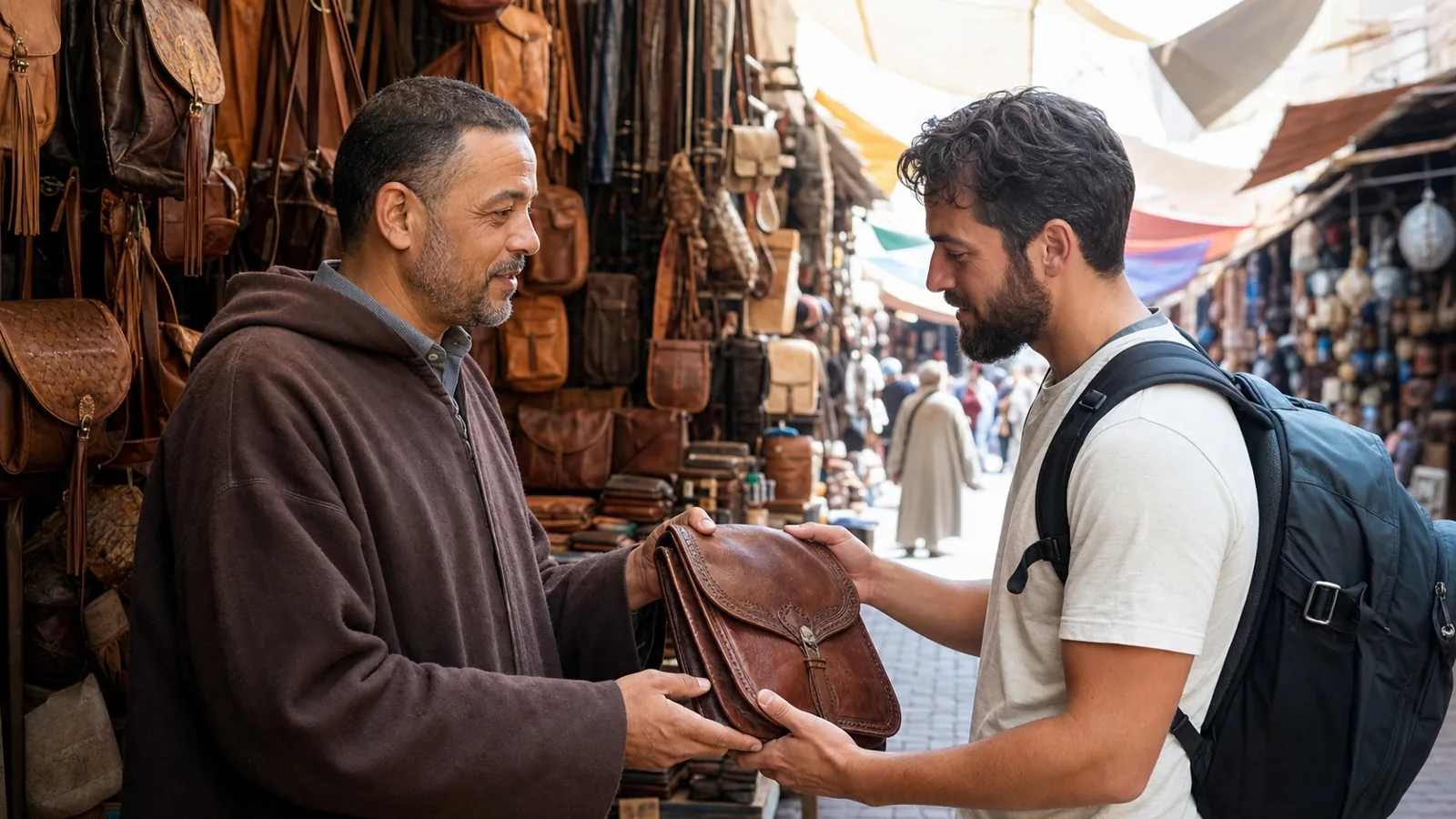
Bargaining is part of the experience in many Marrakech souks, but it should not turn into a war. The city is easier to understand when negotiation is approached with humor, patience and limits. Ask, listen, make a counteroffer if you are interested, and walk away politely if you do not want to buy.
The mistake is not paying a little more than a local; that can happen. The mistake is buying under pressure, getting angry over every price difference, or turning every conversation into a suspicion. There are honest artisans and kind sellers, too. Not everyone is trying to deceive the traveler.
To bargain in Marrakech without stress, ask, listen, counteroffer if you are interested and walk away politely if you do not want to buy.
Accepting “Help” Without Knowing Whether It Is Free
Around the square, the souks and some streets of the Medina, someone may offer to take you to a shop, to “the square,” to a tannery, or to a place that is supposedly closed or only open that day. Sometimes it will be genuine kindness; other times, it will be a way of leading you toward a purchase or asking for a tip.
The healthiest rule is simple: if you need help, ask for it yourself. If someone offers insistently and you are not interested, respond with a clear “no, thank you,” without over-explaining. Courtesy works best when paired with firmness.
If you need help in Marrakech, ask for it yourself and clarify first whether there is a cost.
Underestimating Sensory Fatigue
Marrakech can be intense: noise, motorbikes, grill smoke, perfumes, dust, calls from shopkeepers, heat, music, crowds. What feels fascinating in the morning may feel exhausting by the afternoon.
Do not try to see everything in one day. Alternate the Medina with gardens, quiet terraces, small museums or a long pause at the riad. Marrakech is better enjoyed in layers than as a marathon. Those who try to conquer it at full speed usually end up irritated with a city that, in truth, asks for a different rhythm.
Marrakech is better enjoyed in layers, alternating the Medina with gardens, terraces and quiet pauses.
Ignoring Basic Safety Out of Overconfidence
Marrakech welcomes huge numbers of travelers and, in general terms, can be visited normally if you act with caution. Even so, it is wise to stay alert, especially in tourist areas, markets, crowded places and around gatherings or demonstrations.
Safety in Marrakech improves when you travel without fear, but also without naivety. A calm attitude, a clear route and attention to your belongings usually make a real difference.
There is no need to travel in fear, but there is a need for common sense: keep your wallet secure, your bag closed, be careful with your phone in very crowded areas, pay attention at night on deserted streets, and be cautious with any situation that feels overly persistent. Safety in Marrakech is usually not about major dangers, but about avoiding small lapses.
Safety in Marrakech starts with avoiding small lapses, not with traveling in fear.
Dressing Without Taking the Local Context Into Account
Marrakech is touristy, cosmopolitan and used to visitors, but it is still part of a culture where dressing discreetly often makes the experience much easier. It is not about disguising yourself or giving up your personal style, but about reading the surroundings.
Light, comfortable and slightly more covered clothing helps both out of cultural respect and for protection from the sun. In local neighborhoods, traditional markets or religious spaces, restraint is usually a better companion than unintended provocation.
Light, comfortable and slightly more covered clothing helps with both cultural respect and sun protection.
Treating Local Interaction as a Nuisance
One of the biggest mistakes is thinking every spontaneous conversation is a trap. Another, just as clumsy, is thinking every smile obliges you to buy something. Marrakech lives greatly through words: people ask, offer, negotiate, insist and joke.
The key is to find a middle ground. Say hello. Say thank you. Learn a few basic words in Moroccan Arabic or French. Do not promise to return to a shop if you know you will not. Do not accept tea if you are in a hurry or if you feel uncomfortable with possible commercial pressure afterward. And if someone genuinely helps you, a tip may be appropriate, as long as it comes from clear help and not from imposition.
Traveling respectfully does not mean saying yes to everything. It means saying yes or no politely.
Traveling respectfully in Marrakech does not mean saying yes to everything. It means saying yes or no politely.
Choosing the Wrong Time of Year to Travel to Marrakech
The climate greatly changes the experience. In the hottest months, walking for hours through the Medina can become heavy, especially at midday. During peak travel seasons, the most famous places can feel overcrowded and accommodation prices can rise.
Spring and autumn usually offer a gentler experience, though they are also more in demand. In summer, it is best to organize visits early, rest during the harshest hours and accept that Marrakech is best experienced at dawn and in the late afternoon, when the light softens the walls and the city begins to breathe again.
In summer, organize visits early and rest during the harshest hours of the day.
Who Is Marrakech Worth It For?
Marrakech is worth it for curious, patient travelers, lovers of architecture, hidden courtyards, markets, spiced cuisine, urban photography and cities with character. It is also for those who accept that beauty can come with noise, negotiation and disorder.
Who Might Be Disappointed?
It may disappoint those looking for an escape that is silent, clean, orderly and easy at all times. It may also disappoint travelers who feel overwhelmed by commercial persistence, those who do not enjoy bargaining, or those who expect every corner to feel authentic without any tourist presence.
Marrakech does not reveal itself gently. Sometimes it seduces, sometimes it unsettles. But if you travel with your eyes open, without naivety and without cynicism, the city leaves behind something deeper than a list of monuments: the feeling of having crossed through a place that is alive, contradictory and memorable.