

Book an Agafay Desert dinner from Marrakech with transfer, camel ride, Berber tea, Moroccan dinner, and a sunset show at a desert camp.
View experienceWhere to eat in Marrakech and what to try first
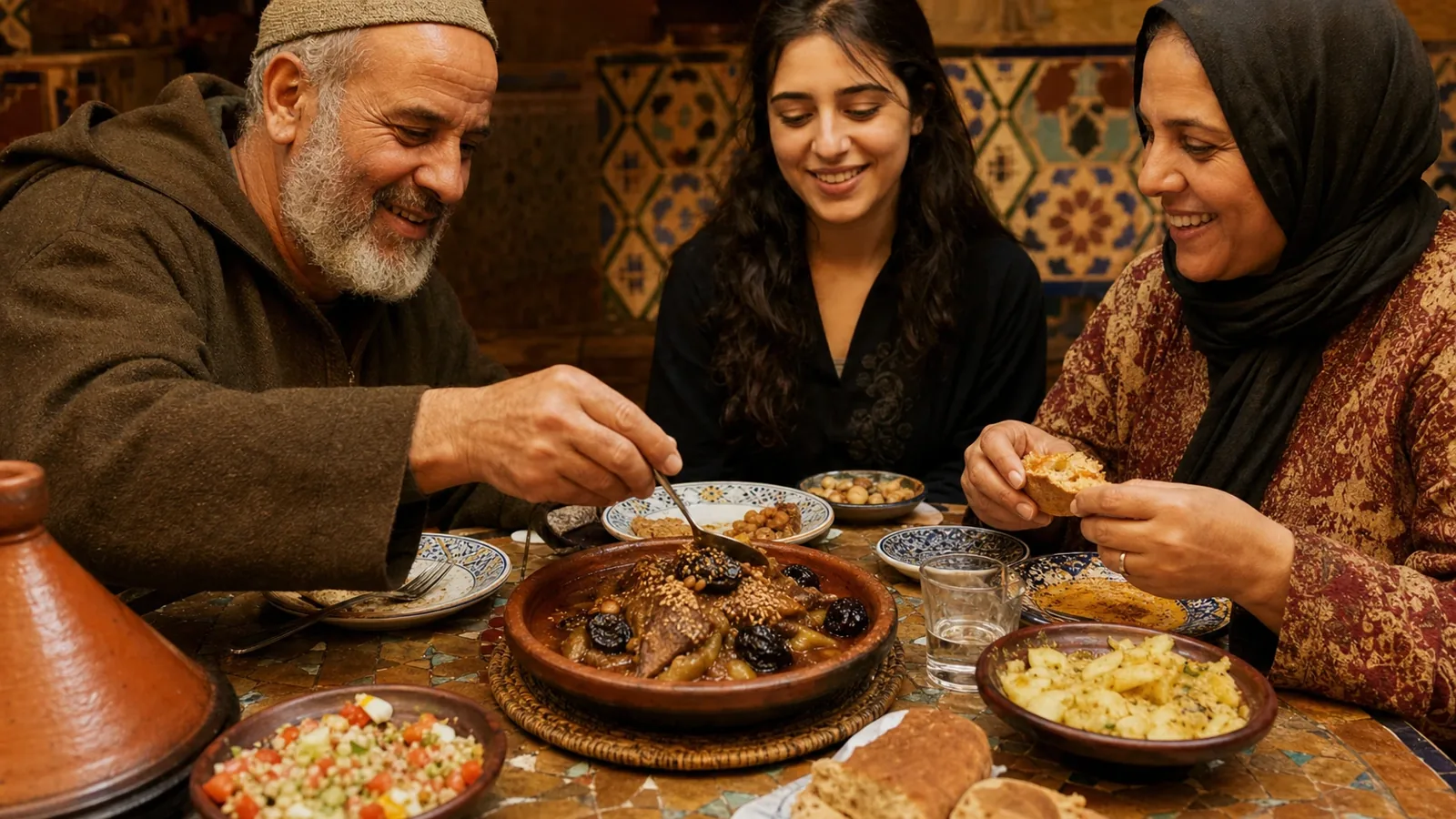
The dish that belongs most clearly to the city is Marrakchi tanjia: meat slow-cooked with spices, smen and lemon in a clay pot, traditionally linked to the heat of public ovens. It is not a light or delicate dish. It is deep, fatty, ancient, the kind of food that tastes of patience. Morocco’s national tourism office presents it as one of Marrakech’s culinary emblems.
Tajine is also worth trying, although not all tajines are created equal. The best have slow-cooked sauce, tender vegetables and well-integrated spices; the worst arrive lukewarm, flat and cooked to be served quickly. Pastilla, both sweet and savory, is often a good test of careful cooking. Harira, briouats, mechoui, skewers and freshly baked bread complete a table where what matters is not sophistication, but balance.
The medina: restaurants among smoke, courtyards and rooftops
The medina is the emotional heart of Marrakech, but also its most uneven area for food. Here you can find an unforgettable meal in a hidden courtyard or a mediocre dinner on a terrace full of raised phones.
For a more polished Moroccan experience, it is worth looking for riad restaurants or traditional houses where the pace is slower. Places such as Dar Zellij, Le Trou Au Mur, L’Mida, Nomad and Le Foundouk often appear in recent selections of Marrakech restaurants, combining Moroccan cuisine, terraces, courtyards and a more contemporary sense of staging.
The advantage of these tables is clear: beautiful atmosphere, more organized service and dishes designed for travelers who want to eat well without improvising too much. There is a downside too: some can feel more international than local, more designed than spontaneous, and in high season it is best to book.
In high season, it is best to book the better-known riad restaurants and terraces.
Jemaa el-Fna: street food with realistic expectations
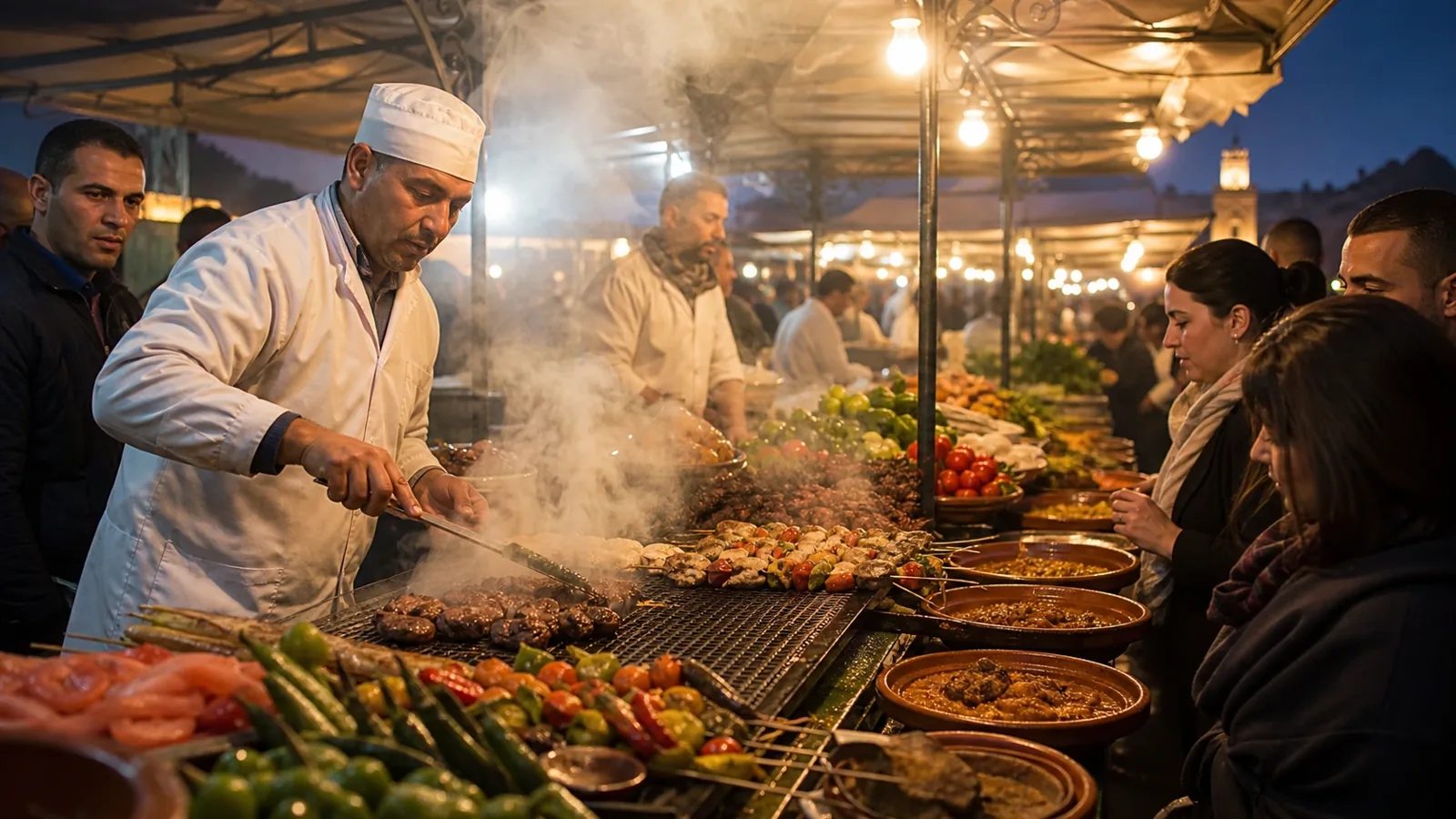
Eating in Jemaa el-Fna can be a fascinating experience, but it is not always gastronomically brilliant. The square is theater, smoke, voices, lights, orange juice, snails, skewers and movement. It is more of a scene than a quiet dinner.
It is worth going at sunset and trying something simple, especially if you are looking for street food in Marrakech with a lively local atmosphere. The medina is known for its food stalls, and areas such as Mechoui Alley are often associated with roast lamb and traditional dishes.
The common mistake is sitting down at the first stall that pressures you too much. It is better to observe, see where locals are eating, ask the price beforehand and avoid ordering a string of dishes without knowing what they will cost. Jemaa el-Fna is not the place for a romantic dinner, nor for anyone overwhelmed by noise. It is for those who accept chaos as part of the menu.
Before ordering in Jemaa el-Fna, observe, ask prices and avoid overly pushy stalls.
Gueliz: comfortable restaurants in contemporary Marrakech
Gueliz, the modern district, changes the rhythm completely. The streets are wider, with cafés, international restaurants, pastry shops, bars and places where the service is more predictable. It does not have the dense magic of the medina, but it can come as a relief after several days of souks, bargaining and alleyways.
Restaurants such as Al Fassia shine here, known for traditional Moroccan cooking and a long-standing reputation, alongside cafés and more cosmopolitan tables. It is also a good area for those traveling with children, older people or anyone who simply needs a dinner that is less theatrical and more comfortable.
Gueliz is not necessarily more authentic, but authenticity does not always mean sitting uncomfortably either. Sometimes, after a day under the sun, a good quiet table is worth more than a postcard.
Eating cheaply in Marrakech without losing dignity
Marrakech allows you to eat cheaply, but you need to choose with some care. The best options are usually simple stalls, small family-run places, bakeries, markets and popular restaurants away from the most photographed streets.
An affordable meal might revolve around skewers, harira, Moroccan sandwiches, msemen, eggs with khlii, sardines, lentils, simple tajines or tanjia in specialized places. Travelers who look for flavor before decoration often enjoy these spots more than many terrace restaurants.
The key is simple: look for basic cleanliness, a steady flow of customers, freshly made food and clear prices. If a place looks empty, expensive and overly pushy, it is probably not the best choice.
Basic cleanliness, steady turnover, freshly made food and clear prices are the best signs.
Sweets, coffee and tea: Marrakech at its slowest
Not everything in Marrakech requires a big meal. Sometimes a mint tea, a gazelle horn pastry, chebakia or a quiet terrace is enough to understand another side of the city. Bacha Coffee, in Dar El Bacha, has become a very well-known address for breakfast and coffee in the medina, although its popularity can bring waits and a feeling less secret than the photos suggest.
For something simpler, a local pastry shop and a glass of tea can be more memorable than a famous table. Marrakech rewards the traveler who is not only looking for the recommended place, but for the right moment.
Dishes you should try at least once
Tanjia: intense, slow, meaty and deeply Marrakchi. Better at lunchtime than as a heavy dinner.
Pastilla: crisp, spiced, sweet and savory. A good pastilla can become one of the great memories of the trip.
Harira: a humble, comforting soup, ideal if you want something local without an endless meal.
Mechoui: roast lamb, simple and powerful. When it is done well, it does not need much explanation.
Mint tea: it is not just a drink. It is a pause, a welcome, a negotiation, an after-meal ritual and a social gesture.
Tourist traps worth avoiding
Be wary of restaurants that loudly promise the best food in Marrakech from the doorway. Be careful, too, with terraces where the view is magnificent but the kitchen seems secondary. A bad meal with a view is still a bad meal.
Another common mistake is ordering only the familiar dishes. If you eat chicken tajine with lemon every day in tourist restaurants, you will end up thinking Moroccan food is repetitive. It is not. What is repetitive is usually the tourist menu.
It is also worth checking whether the restaurant serves alcohol if that matters to you. Not all places in Marrakech are licensed, and it should not be taken for granted.
A bad meal with a view is still a bad meal.
Who will enjoy eating in Marrakech
Marrakech thrills curious travelers, lovers of spices, long meals, shaded courtyards, food with history and cities where eating also means looking, listening and smelling.
It may disappoint those looking for flawless service everywhere, very light flavors, silent dinners or a food scene that is easy to decode. Marrakech requires patience. Sometimes it rewards you generously; sometimes it wears you out.
The best strategy for eating well
The ideal approach is to combine. One night on a beautiful terrace in the medina, a popular lunch of tanjia or mechoui, a comfortable dinner in Gueliz, a slow breakfast, a street-food stop and at least one well-chosen traditional table. That way, Marrakech is reduced neither to a postcard nor to a trap: it becomes a city with layers.
Eating in Marrakech is worth it when you travel with real hunger, not just with a list of famous restaurants. The city will not always be gentle, orderly or easy. But when it gets it right, when the bread arrives hot, the preserved lemon perfumes the plate and the tea leaves a sweet cloud in your mouth, Marrakech stays with you long after the meal is over.