Getting around Naples and choosing the right transport
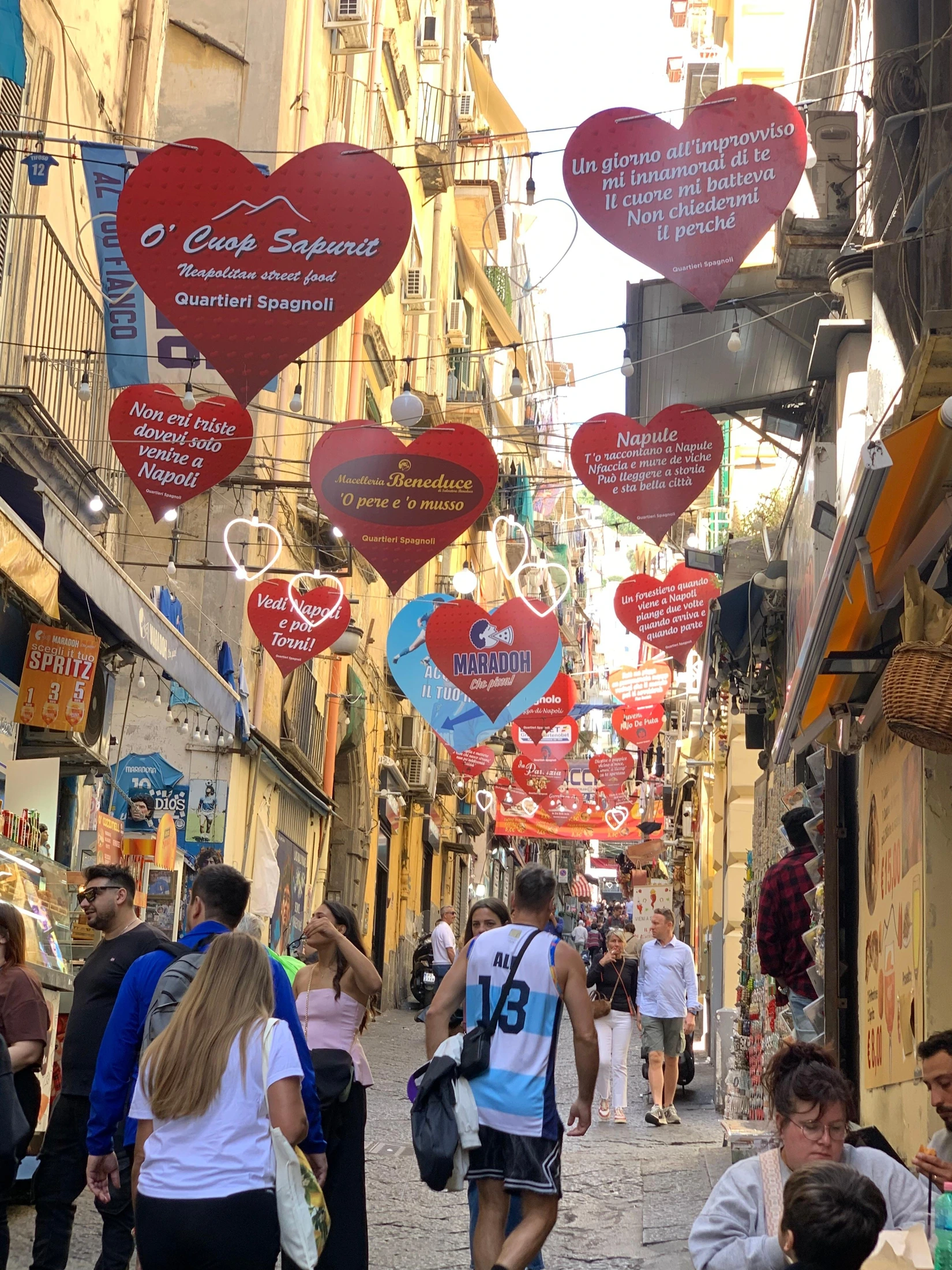
Hanging hearts above a street in the Spanish Quarters place this guide in the Naples you explore on foot. When connecting neighbourhoods, consider both distance and elevation.
The Maradona mural on a facade in the Spanish Quarters and the open stairways in the Palazzo San Felice courtyard in La Sanità provide context for two different urban walks. Walking, the metro or a funicular suits different journeys; reaching the palace does not guarantee access inside. Excursions beyond Naples need their own planning.
Group nearby visits and check the paving and hills along your route.
Combine the metro and funiculars according to your starting point, destination and final walk.
Plan Pompeii, Herculaneum, the islands and Vesuvius as excursions outside the city.
Hotels
Accommodation in Naples
The card searches accommodation in Naples and reuses this guide’s thematic image. Hanging hearts above a street in the Spanish Quarters. Scene in Naples for this thematic guide.
Walking through the historic centre lets you connect streets such as Spaccanapoli and Via dei Tribunali without missing what lies between monuments. The journey is part of the visit: façades, shops and narrow intersections make more sense from the pavement than from a vehicle.
The mistake is assuming that nearby means easy. Uneven paving, traffic and crowds can make walks more demanding than expected. Choose a main route and group your visits around it. If you have a pushchair or reduced mobility, check the specific route: two places close together on a map do not guarantee easy access.
Quartieri Spagnoli: approach from Toledo and assess the climb
Via Toledo provides a clear starting point for reaching the Quartieri Spagnoli. From there, explore the neighbourhood’s streets on foot, remembering that some climb towards the hill. Decide how far uphill you want to go and where you will leave the neighbourhood, especially if you are continuing elsewhere.
If you want to see the area around the Maradona mural, locate it beforehand rather than wandering through alleyways expecting to find it immediately. You need not cross the entire neighbourhood to appreciate its street layout. Keep entrances to homes and businesses clear: stopping to look should not disrupt street life.
Maradona mural on a facade in the Spanish Quarters. Scene in Naples for this thematic guide.
La Sanità: a visit in its own right
Give La Sanità its own part of your itinerary. Palazzo San Felice is in this neighbourhood, offering a specific architectural focus for a walk instead of another scattered address in an already busy day.
Its position relative to the upper city matters: continuing to Capodimonte means gaining elevation. Decide whether to explore La Sanità alone or combine it with a hilltop visit; the effort differs. At the palace, distinguish reaching the building from entering it. Do not assume free access to courtyards or staircases, and respect any instructions displayed.
The metro: connect areas and consider the final stretch
The metro helps connect areas that would be impractical to cover on foot in one day. Line 1 has useful reference points including Garibaldi, Museo, Dante, Toledo and Vanvitelli. Line 2 provides another urban rail corridor, with stations such as Piazza Amedeo and Mergellina.
Choose a station for its location relative to your destination, not simply because its name is familiar. You may still face a hill or a substantial walk after exiting. Avoid extra changes to save a distance you could comfortably walk. Check that day’s services and your ticket’s conditions, including its validity across transport modes: tickets do not necessarily offer the same coverage.
Funiculars: gain height before covering distance
Consider the funiculars alongside the metro for reaching Vomero. The Centrale, Chiaia and Montesanto connections serve different routes between the lower city and the hill. Your choice depends on where your journey starts and ends.
For the area around Castel Sant’Elmo and Certosa di San Martino, first consider how to gain height, then the final walk. Going up one way and down another can add variety, provided services allow it. Do not plan a whole day assuming every connection will be running: check the one you need.
The waterfront and buses: judge the distance
Walking around Castel dell’Ovo and continuing towards Chiaia offers a sense of Naples’ relationship with the sea. Extending the walk to Mergellina, however, changes its scale. A short stroll can end up taking much of the day.
Buses are useful when your destination is far from a station or you want to avoid a long stretch. Their suitability depends on the route and traffic. Allow extra time for a timed visit. For a walk without a fixed commitment, weigh waiting and travelling against walking part of the way and returning by another means.
Cars and taxis: two separate decisions
Hiring a car to visit the centre adds tasks: finding parking, checking access restrictions and deciding where to leave it while you walk. If your accommodation and visits are within the city, public transport and walking are usually simpler.
A taxi serves a different purpose. It can help with luggage, tiredness or a destination awkward to reach from your starting point. Before getting in, confirm how the fare will be calculated and give the exact address. In narrow streets, the vehicle may not reach the door. Convenience also depends on that final stretch, not just the drive.
Pompeii, Herculaneum and the islands: beyond urban transport
Pompeii and Herculaneum are excursions outside Naples, not simply two more urban metro stops. The departure station, train service and entrance to your chosen site need separate attention. Check the return journey before starting your visit.
For Capri, Ischia or Procida, check the departure port, exact destination and sailing conditions. Where a service leaves from matters as much as which island it reaches. If you also want to visit Vesuvius, plan access separately: reaching Pompeii or Herculaneum does not automatically solve the climb. Combining excursions without checking these connections often produces days dominated by travel.
One approach for visitors, another for residents
On a first visit, build each day around a lower or upper part of the city, using transport to connect them when it offers a clear advantage. A day in the historic centre calls for different choices from one in Vomero.
If you live in Naples, choose a route that differs from your usual journeys: explore La Sanità for its architecture or combine a climb to Vomero with a different return route. In either case, consider the whole journey, including the return. Getting around well means spending your energy on what you want to see and choosing transport that makes your plan work.
C
DiscoverCars
Car rental
Compare prices and book your rental car at the best price.
Combine a ride on the Funicolare Centrale with a guided walk downhill from Vomero via Via Palizzi and the Petraio steps. Over an advertised 2 hours, the route brings together gulf views, residential streets and the contrasts of Q…
The advertised duration is 2 hours. Individual walking times cannot be assigned to specific streets, and the itinerary may change.
Combine the urban HISTORIC Line A route with PANORAMIC Line B and choose where to get off. The ticket is advertised as a 24-hour pass, valid for one day from first activation; check how activation works and which operating hours…
Allow time for visits and possible waits in addition to the advertised 45- and 70-minute circuits. One-day validity from first activation is a separate condition; check how it applies to operating hours.
Combine artistic stations on line 1 with walks around nearby parts of Naples. An in-person guide from Naples bay tour explains the art, architecture and connections between the city's past and modern identity. The experience incl…
Allow for the advertised 2-hour visit. The itinerary may change, and its listed segments do not account for the full advertised duration.

 Activity on TourBookGo