

Book a snorkelling cruise from Nice: 2 hours along the French Riviera, with a swim stop in Villefranche and views of Saint-Jean-Cap-Ferrat.
View experienceWhat to eat in Nice if you want to understand the city
Socca is the first bite you should try: a thin chickpea-flour pancake, crisp at the edges, soft in the middle, served hot and peppered. In traditional places such as Chez Thérésa, the Nice Côte d’Azur Tourist Office presents it as a wood-fired speciality, alongside pissaladière and Swiss chard tart. Office de Tourisme Nice Côte d'Azur
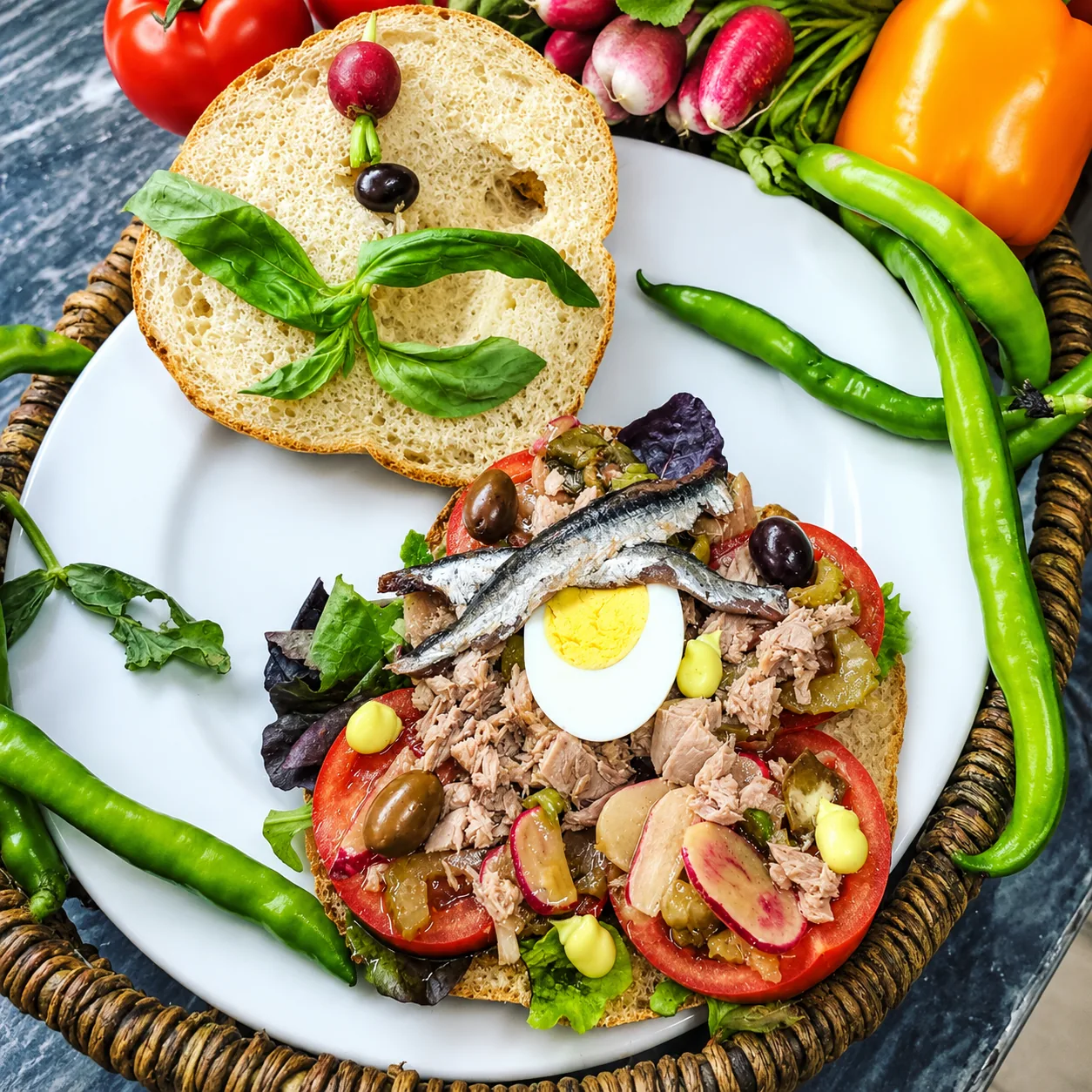
Pissaladière looks like pizza, but it is not quite the same: it is topped with slow-cooked onions, anchovies and olives, with that salty-sweet taste of Mediterranean ports. Pan bagnat is the more honest, street-food version of salade niçoise: round bread, tomato, egg, tuna or anchovy, olives, vegetables and olive oil. A well-made salade niçoise should not be just any heap of cold ingredients, but a fresh composition of vegetables, mesclun, tomato, peppers, young artichoke and radish, according to the traditional description used by local tourism authorities. Office de Tourisme Nice Côte d'Azur
It is also worth looking out for petits farcis, stuffed vegetables; Niçois ravioli with daube, a rich beef stew; tourte de blettes, a sweet Swiss chard tart that surprises more than it seduces at first bite; and barbajuans, small fried parcels with a filling, deeply tied to the region.
Cours Saleya: beautiful, useful, but not always cheap
Cours Saleya, in the heart of Vieux Nice, is one of the most photogenic places to start the day: colourful awnings, flowers, fruit, vegetables, local specialities and terraces that fill up from morning until night. The tourist office describes it as a lively corner of the old town, famous for its flower market, local produce, crafts and gastronomic specialities. Office de Tourisme Nice Côte d'Azur
It is worth going early, when the city still smells of bread, coffee and damp stone. For cheap eats in Nice, the best option is not always to sit at the most visible terrace, but to buy something simple: socca, pissaladière, pan bagnat or seasonal fruit. For a long meal, read the menu carefully. If it mixes too many cuisines, has huge photos and promises “specialities” from all over France, it is probably not the most interesting place.
For cheap food, the best option is not always to sit at the most visible terrace, but to buy something simple.
Vieux Nice: the area with the most character, and the most traps
The old town is the most atmospheric place for dinner: narrow lanes, green shutters, ochre façades, the smell of garlic and tiny tables taking over almost the entire pavement. It is an ideal area to try traditional Niçois cooking, but also the one most prone to tourist-trap restaurants.
Look for short menus, daily specials, mentions of seasonal produce and, for a more reliable taste of local cuisine, the Cuisine Nissarde label. This distinction is awarded to establishments that respect the traditional recipes, ingredients, proportions and preparation methods of Niçois cuisine. Office de Tourisme Nice Côte d'Azur
For a first dinner, Vieux Nice works very well if you do not mind the noise, the close-set tables and the touristy atmosphere. If you want absolute calm or an intimate conversation without interruptions, it may be better to book on quieter streets or head towards the port.
Look for short menus, daily specials, seasonal produce and the Cuisine Nissarde label for more assurance.
Where to eat socca in Nice
For socca in Nice, two names come up again and again for a clear reason: Chez Thérésa and Chez Pipo. Chez Thérésa is associated with Cours Saleya and Vieux Nice, and the tourist office presents it as a local institution dating back to 1925. Office de Tourisme Nice Côte d'Azur
Chez Pipo, near the port, is also listed by the tourist office as a place known to Niçois locals for tasting socca, generation after generation. Office de Tourisme Nice Côte d'Azur
Do not expect ceremony. Socca is finger food, napkin food, quick-table food. If it has just come out of the oven, all it needs is pepper and appetite. If it arrives lukewarm, rubbery or reheated, it loses much of its charm.
Good-value restaurants in Nice
Nice is not a cheap city, but it still has bistros where you can eat well without entering Riviera-luxury territory. The MICHELIN Guide includes in its Nice Bib Gourmand selection restaurants such as Chez Davia, Bistrot d’Antoine, Olive & Artichaut, La Merenda, L’Alchimie, Les Plaisirs and L’Orangerie, a useful clue for anyone looking for careful cooking at relatively moderate prices within the local context. Michelin Guide
Even so, booking is advisable. Small places fill up quickly, especially in spring, summer, at weekends and during events. In Nice, improvising at lunchtime can work out well; at night, in high season, it often ends at a mediocre terrace, paying more than you wanted.
Booking is advisable, especially in spring, summer, at weekends and during events.
Eating cheaply in Nice without settling
The best affordable food in Nice is not always in a restaurant. It might be a slice of socca, a well-made pan bagnat, a takeaway pissaladière or a picnic bought at the market. When the weather is kind, eating on a bench facing the sea or in a quiet square can be more memorable than a cramped table on an overcrowded street.
The Libération district often feels more local and less staged than the old town. It is a good area for cafés, market produce, bakeries and simple meals. It does not have the instant postcard appeal of Vieux Nice, but it offers a more everyday Nice, less concerned with the visitor’s camera.
For a special dinner
For a more polished dinner, the port and certain streets in the centre offer a more grown-up Nice: fewer shouts, fewer tourist menus, more produce-led cooking. In recent years, the local food scene has become more diverse, with restaurants combining Niçois tradition, local ingredients, natural wines and more creative ideas. Le Monde highlighted precisely this culinary revival, between tradition and renewed gastronomic energy. Le Monde.fr
The delicate part is not confusing “elegant” with “authentic”. There are beautiful restaurants where the food takes second place. Look at the menu before going in, be wary of empty places at peak dining time when everything around them is full, and do not choose on the basis of the view alone.
Do not confuse “elegant” with “authentic”: look at the menu before going in and do not choose on the basis of the view alone.
Mistakes to avoid when choosing where to eat in Nice
The first mistake is always eating on the Promenade des Anglais and expecting the best local cuisine. There may be good options, but many tables live more from their location than from what is on the plate.
The second is ordering salade niçoise anywhere without checking what is in it. When it arrives loaded with unrelated ingredients, heavy sauces or the look of food prepared hours in advance, it is better to choose something else.
The third is dining too late without a reservation. Nice has nightlife, but many good restaurants do not operate with the endless flexibility imagined by the Mediterranean traveller.
The fourth is assuming that everything traditional will be light. Local cooking has sunshine and vegetables, yes, but also fried food, oil, bread, fillings and stews.
So where should you eat in Nice?
Eat in Cours Saleya in the morning, but choose carefully. Try socca in a specialist address. Look for the Cuisine Nissarde label if you want local recipes with a little more assurance. Book a small bistro for the evening. Move one or two streets away from the most obvious areas. And leave at least one simple meal for the market, the bread, the olive oil and the sea in the background.
Nice is best enjoyed when you are not looking for luxury all the time. Sometimes its finest flavour is found in a hot slice of socca eaten standing up, fingers dusted with pepper, as the noise of the old town rises up the façades.