
What Is the Best Way to Get Around Osaka?
For most travelers, the most effective combination is simple:
Use the metro to travel around the city center, JR trains for certain outlying districts and day trips, and walk once you arrive in each area.
Osaka revolves around two major urban centers: Kita, centered on Osaka-Umeda, and Minami, home to Namba, Shinsaibashi, and much of the city’s nightlife. The metro makes it easy to travel between the two, while the Osaka Loop Line is useful for connecting major stations and transferring to other railway networks.
Osaka Metro: The Most Practical Option
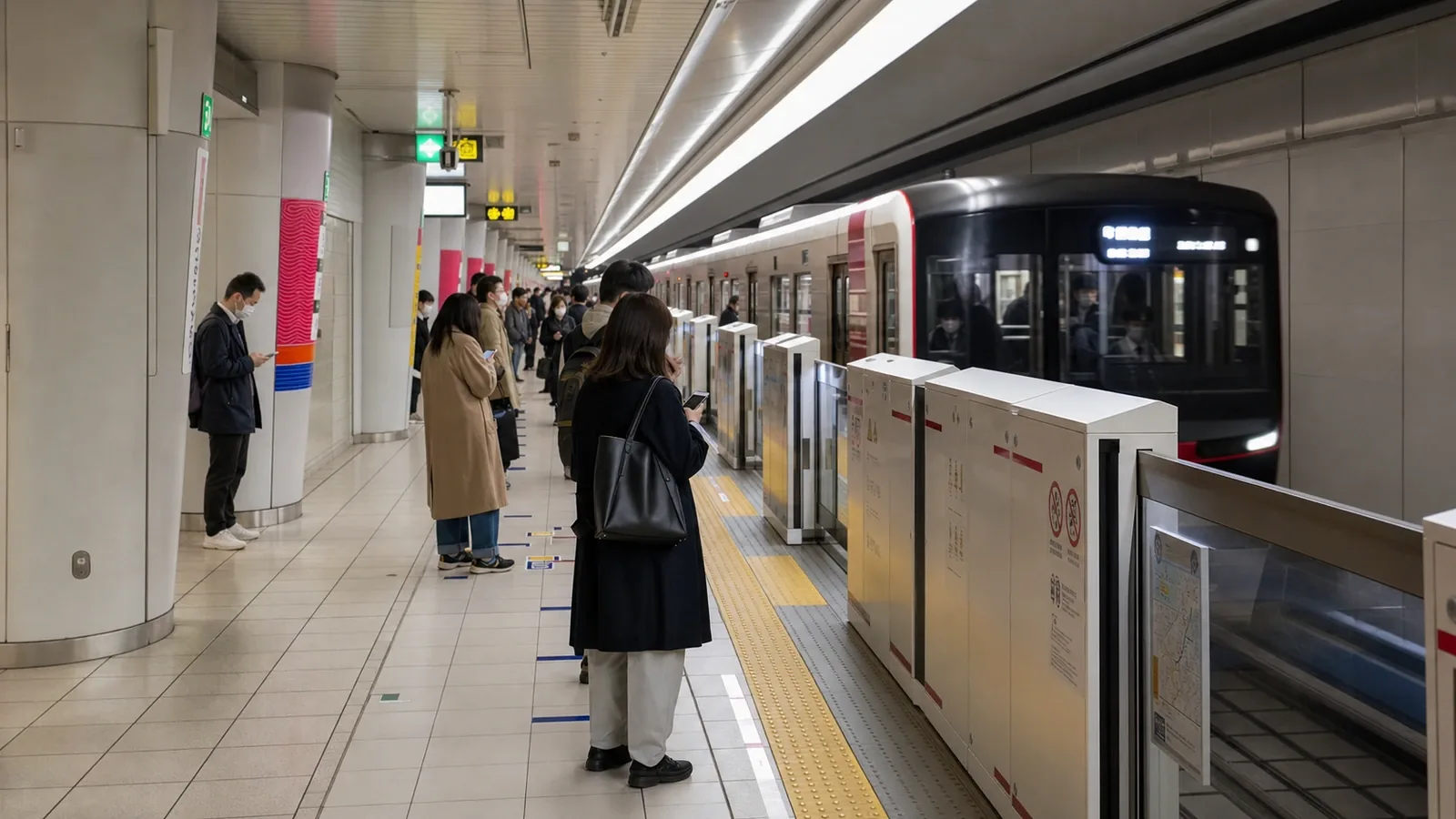
Osaka Metro is usually the most intuitive form of transport for first-time visitors. Its lines run through the main tourist districts, forming a convenient grid beneath the city.
The most important line for travelers is the Midosuji Line, easily recognized by its red color. It connects Shin-Osaka, Umeda, Shinsaibashi, Namba, and Tennoji—stations that are likely to appear repeatedly in almost any itinerary.
There is no need to memorize the Japanese names. Lines are identified by colors and letters, while stations are numbered, which becomes especially helpful when tiredness starts to affect your sense of direction. Pay attention not only to the station name, but also to its number and the train’s final destination.
The Metro’s One Minor Drawback
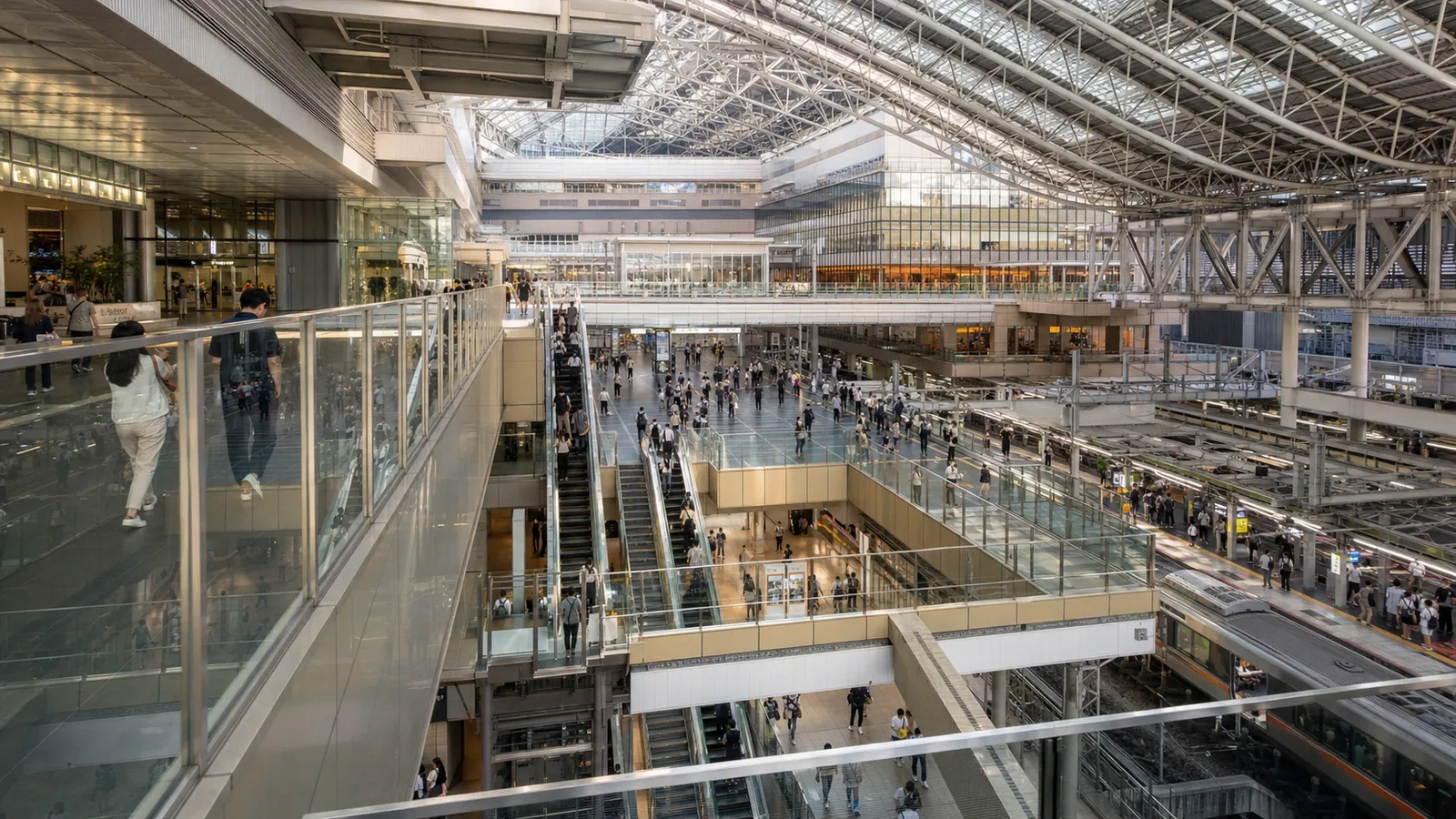
The network is efficient, but some stations are effectively underground cities. Umeda, Osaka, Higashi-Umeda, and Nishi-Umeda form a vast complex of corridors, shopping malls, and entrances, even though they are not a single station with one shared platform area. Osaka Metro even allows out-of-gate transfers between some of these stations.
A transfer that looks straightforward may involve ten or fifteen minutes of walking underground. At large stations, choosing the right exit can save more time than catching the fastest train.
JR Trains in Osaka: Useful, but Not Always Necessary Downtown
The JR network is convenient for reaching areas such as Osaka Castle, Tennoji, Shin-Osaka, and Universal City, as well as for continuing to other cities in Kansai.
The Osaka Loop Line circles much of the city center and works like a circular railway route. It is useful, although the Midosuji metro line is usually more direct for journeys between Umeda, Shinsaibashi, and Namba.
Travelers with a Japan Rail Pass may be tempted to use JR exclusively. This can reduce some costs, but it is not always worthwhile: many tourist districts are better served by the metro or private railway companies.
ICOCA Card in Osaka: An Easier Way to Travel
The rechargeable ICOCA card allows you to enter and exit trains, metros, and buses simply by tapping it against the ticket gate reader. It is also accepted as payment at many businesses displaying the relevant symbol and can be used on compatible transport networks in other parts of Japan.
Its greatest advantage is not necessarily saving money, but convenience. It removes the need to calculate the fare for every journey, search for coins, or figure out the ticket machines each time you change operators.
Osaka transport passes may be worthwhile on days involving frequent travel, but they should not be purchased automatically. If the plan is to explore Namba and Shinsaibashi at a leisurely pace, you may use public transport very little. If you intend to combine Umeda, Osaka Castle, Tennoji, and the bay area in one day, a pass may make more sense. Osaka Metro offers different pass types with varying conditions, so check the current options before buying one.
Can You Explore Osaka on Foot?
Yes, but not all at once.
Osaka rewards travelers who take a train to a district and then explore it on foot. Many of the city’s most memorable scenes appear between stations: tiny restaurants beneath the railway tracks, covered shopping arcades, quiet temples surrounded by buildings, and narrow lanes lit by lanterns.
These areas are particularly well suited to walking:
Namba, Dotonbori, Shinsaibashi, and Amerikamura.
Umeda and the area around Osaka Station.
Shinsekai and Tennoji.
Osaka Castle and its park.
Nakazakicho and Tenma.
Kuromon Market and Nipponbashi.
A common mistake is to assume that two districts that look close on the map will also feel close in practice. Osaka has wide avenues, enormous stations, and underground crossings that make distances longer than expected. In addition, the humid summer heat can turn a pleasant walk into an endurance test.
Buses in Osaka: Useful, but Less Intuitive
City buses reach places located some distance from railway stations, but they are rarely the first choice for a short visit. Their routes are harder to understand than the metro system, and traffic can cause delays.
They make sense for specific destinations, for travelers with limited mobility, or when they avoid an inconvenient combination of trains. On most sightseeing itineraries, buses will be a supplement rather than the main form of transport.
Taxis in Osaka: When They Are Worth It
Taxis are clean, safe, and useful when traveling with luggage, young children, or a group of several people. They can also provide a convenient way back to your hotel after train services have ended.
They are not the best option for crossing Osaka during busy traffic periods. Urban distances can quickly increase the fare, and the metro will be faster on many routes.
At major stations, look for official taxi ranks. Showing the hotel name written in Japanese or pointing to the destination on a map can help prevent confusion.
Is It Worth Renting a Car in Osaka?
For a visit limited to the city itself, usually not.
Osaka has an extensive public transport network, while driving involves heavy traffic, urban expressways, expensive parking, and car parks that may fill up on weekends and public holidays. The city’s tourism office also warns about congestion and the difficulty of finding parking in areas such as Umeda and Namba.
A car begins to make sense when Osaka is being used as a base for exploring villages, mountains, or rural areas with limited public transport. Even then, it may be more convenient to collect the car when leaving the city rather than keeping it parked for several days.
How to Get from Kansai Airport to Osaka
The best option depends mainly on where your accommodation is located.
To Namba and Minami
Nankai trains connect the airport directly with Namba. The fastest Rapi:t services complete the journey in approximately 34 minutes, while the Airport Express takes around 45 minutes.
This is the most logical option for travelers staying near Namba, Dotonbori, or Shinsaibashi.
To Tennoji, Osaka-Umeda, or Shin-Osaka
JR services are convenient for reaching Tennoji and continuing to Osaka Station, Shin-Osaka, or Kyoto. The railway station is connected to the second floor of Terminal 1, and both JR and Nankai services operate from there.
Airport buses can be convenient when they stop near your hotel, especially if you have bulky luggage, although journey times are affected by traffic.
How to Plan Osaka Journeys Without Losing Half the Day
The best strategy is to group attractions by area:
North
Umeda, Osaka Station, Nakazakicho, and Tenma can be combined in a single day.
Central and South
Shinsaibashi, Amerikamura, Dotonbori, Namba, and Kuromon form a fairly natural route that can be completed largely on foot.
East
Osaka Castle and its gardens deserve their own block of time, especially if you plan to explore them at a relaxed pace.
Tennoji and Shinsekai
Tennoji, Abeno, and Shinsekai fit together well. From there, it is also easy to continue to other destinations in southern Osaka.
Bay Area
Universal Studios Japan, the aquarium, and the harbor area require dedicated journeys. They should not be treated as quick stops to squeeze between city-center attractions.
Common Mistakes When Getting Around Osaka
The first is trying to visit too many districts in one day. Osaka’s transport is fast, but its stations consume both time and energy.
The second is confusing Osaka Station with Shin-Osaka. Osaka Station is in Umeda, while Shin-Osaka is the main Shinkansen station farther north.
The third is relying only on the journey time shown in an app. A ten-minute train ride may conceal a long walk to the platform, an underground transfer, and an exit located on the far side of the district.
It is also advisable to avoid rush hour whenever possible. Trains can become crowded, and traveling with large suitcases becomes uncomfortable for both visitors and commuters.
Verdict: A Simple City to Navigate Once You Accept Its Scale
Getting around Osaka is not difficult, but it requires abandoning the idea that everything is nearby. The city works best in sections: take a fast train between districts, then leave enough time to walk, browse shop windows, step into an izakaya, and follow the streets wherever they lead.
The metro will be your main ally, JR will be useful for certain journeys and day trips, and a car can be left out of an urban itinerary. The real challenge is not finding transport, but resisting the temptation to cross Osaka too many times in a single day.
