
Start with the conditions you tolerate
There is no universally best time to visit Pamukkale. Your choice depends on your heat tolerance, concern about rain, and intended time outdoors among the travertines and Hierapolis ruins. Official Denizli climate statistics show a clear contrast: July and August have the highest average temperatures and fewest rainy days, while December and January are colder and wetter.
These figures describe a regional pattern observed over decades, not the weather on a particular day. They cannot predict visitor numbers, accommodation prices, open areas, or ground conditions. A sensible decision combines historical climate data with an official forecast checked shortly before departure.
Summer: drier weather in exchange for greater heat
Summer suits travellers who want to reduce the likelihood of rain and can explore an outdoor site in high temperatures. Planning may be more predictable, but the visit is not effortless. The heritage complex involves walking between terraces and archaeological structures, and heat may slow your pace before you have seen everything planned.
Plan a selective day, prioritising what genuinely interests you instead of covering the entire site out of obligation. Travellers who enjoy long walks and cope with heat may find summer suitable. For families with young children, heat-sensitive people, or anyone needing frequent breaks, the same conditions can be exhausting.
A drier summer does not guarantee clear skies, full access, or comfortable surfaces. The forecast, official site information, and staff instructions remain decisive.
Winter: a visit more exposed to cold and rain
December and January bring colder, wetter regional conditions. This does not rule out a trip, but changes its logic. Pamukkale is not merely a formation viewed from a lookout: much of the experience involves moving through an open landscape and connecting it with Hierapolis. In adverse weather, the reasonable visit length and number of places enjoyed calmly may decrease.
Winter may suit travellers prepared for a short, adaptable plan. Distinguish what you would like to see from what is essential, deciding which part of the complex to prioritise if rain or cold makes a longer route uncomfortable.
Do not assume that a cooler season means fewer visitors, lower prices, or easier access. These variables require separate checks.
Spring and autumn: seek balance without assuming it
The transitional months appeal to travellers avoiding the extremes of summer and winter. However, shoulder season does not automatically mean mild weather, little rain, or less tourism pressure. Regional statistics provide context, but they neither replace a specific forecast nor confirm site conditions.
These periods suit flexible travellers who can change the route order, shorten an outdoor section, or devote more attention to the ruins if conditions shift. They offer no guaranteed ideal day, but may provide a reasonable compromise between priorities.
Before booking a particular date, check transport, accommodation, and access conditions separately.
Hierapolis, terraces and water under the same light
White terraces, the ruins of Hierapolis, and thermal water explain why light and weather matter here. They form a natural and cultural landscape best understood with time to observe how its elements relate. A clear-sky scene may suggest this perspective, but should not be treated as a weather promise.
Good light can enhance reliefs, archaeological forms, and the travertine contrast. Even so, organising the trip around a bright image would be a mistake. The sky may change, while conservation requirements determine where visitors may walk and which areas can be used.
This part deserves its own time in the itinerary. Choosing a season also means deciding how much leeway to give an outdoor route that should not be rushed.
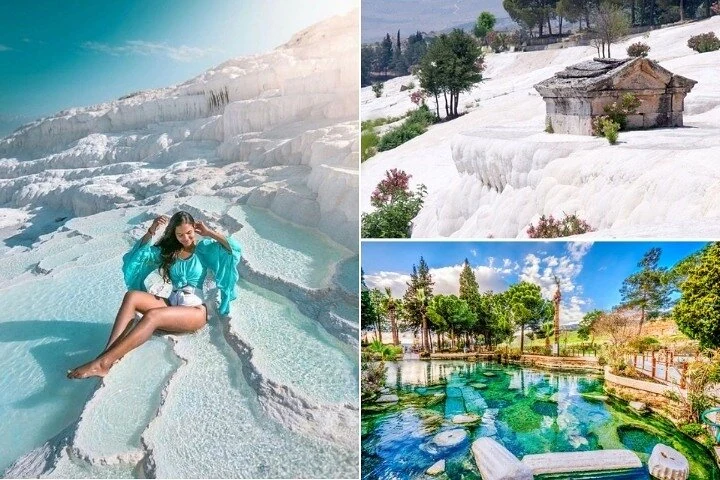
The travertines affect the weather decision
A barefoot visitor in a shallow pool illustrates a common aspect of the travertine route, but does not prove every terrace is open for walking or bathing. General access is restricted to protect the complex, and only designated areas allow contact with water. Signs and on-site instructions always take precedence.
Weather therefore has practical consequences. Heat, cold, or rain can alter comfort when the body is more exposed than during an urban visit. Do not presume the water temperature, accessibility of an area, or surface condition.
Anyone with specific mobility needs should confirm current conditions rather than infer them from photographs or general descriptions.
Crowds and budget are separate from the weather
Pamukkale faces substantial visitor pressure requiring conservation measures, but weather averages do not reveal which day will be busiest or whether a season will be cheap or expensive. Accommodation, transport, admission, and optional activities may vary for unrelated reasons.
If avoiding crowds is a priority, choosing a season by intuition is insufficient. Check current information and retain route alternatives. Travellers on limited budgets should compare actual conditions for their dates instead of assuming winter or shoulder season offers financial advantages.
Residents and visitors can choose differently
Anyone travelling from far away should usually choose the season according to what they tolerate least: intense heat, cold, or rain. Allow enough flexibility so an imperfect day does not undermine the trip's main purpose.
Residents of Denizli or nearby towns can check the official forecast and choose favourable conditions for observing the relationship between the travertines and Hierapolis at a relaxed pace, rather than relying on a fixed date. Proximity permits decisions based on actual conditions instead of seasonal promises.
The most honest recommendation
Summer favours travellers who prefer a warmer, drier pattern and tolerate heat. Winter requires greater tolerance of cold, rain, and possible plan changes. Spring and autumn may offer a middle ground, but guarantee neither balanced weather, fewer visitors, nor better prices.
The best time for Pamukkale is when the likely weather matches your ability to explore an outdoor complex of travertines and ruins. Check the official forecast, confirm site conditions, and keep your itinerary flexible. Choosing well is not about chasing a perfect postcard, but leaving enough room to understand the landscape without forcing the experience.