First, divide the map into several areas
Getting around Pamukkale becomes easier once you stop thinking of all its attractions as one continuous area. The Hierapolis-Pamukkale complex forms the main hub, while Karahayıt, Laodicea, Denizli and other nearby places appear as separate areas on official tourist routes.
This distinction changes how the visit should be planned. Within the heritage site, movement is shaped by conservation requirements and the routes open to visitors. Beyond it, every extension requires a separate transfer. Before setting out, decide how much of the day will be devoted to the archaeological and natural core and which places will be treated as independent excursions. Trying to connect everything spontaneously can turn the visit into a sequence of poorly coordinated journeys.
Arriving from Denizli by public transport
The municipal transport website lists route 230 between Ulu Cami and Pamukkale, passing through the area around Denizli bus station. It is a useful connection for travellers staying in the city, arriving there from another destination or preferring not to drive.
Do not assume that a frequency, specific stop or timetable remembered from a previous search is still valid. Routes and services may change, so the sensible approach is to check the municipal website on the day and confirm which stop is operating in each direction. Night services, universal accessibility and luggage space should not be taken for granted either.
For visitors, this route makes it possible to plan Pamukkale as a separate day trip from Denizli. For local residents, it can provide a starting point for organising a car-free day, provided that the return journey is checked before the visit begins.
Inside Hierapolis-Pamukkale, the site sets the rules
Once inside the heritage site, private vehicles are no longer the main means of getting around. Access for private cars is restricted except in emergencies, and the site management provides visitor routes and internal public transport. These restrictions are not arbitrary inconveniences: they protect both the travertine landscape and an archaeological city exposed to heavy visitor pressure.
The route combines the terraces with Hierapolis structures such as the theatre, necropolis, baths, monumental gates and other remains. Their presence within the same complex does not mean that every section is level, accessible or suitable for everyone. Nor should visitors assume that all areas allow unrestricted access or bathing.
The sensible strategy is to follow the current signs, ask staff whenever a route is unclear and adapt the itinerary to actual conditions. The site’s official website should be consulted before travelling, since entrances and operating conditions may change.
Laodicea requires its own transfer
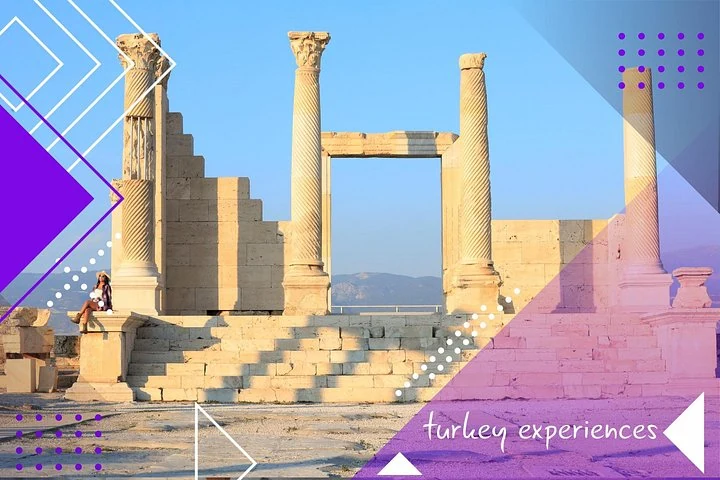
Laodicea is neither a walkable extension of central Pamukkale nor a section of Hierapolis. It is a nearby archaeological excursion in the Denizli area, presented as a separate stop on official routes. Including it in the trip requires planning both how to get there and how to continue afterwards.
The main decision is not simply whether it deserves a stop, but what you are willing to sacrifice to include it. Travellers with only one day may find it more coherent to focus on Hierapolis, the archaeological museum and the travertines. With more time, keeping Laodicea separate from the main complex prevents both places from being reduced to a rushed visit.
Do not plan the connection around assumed journey times. Check the transport available on the chosen date and consider whether a private option provides enough extra flexibility. Regional proximity does not mean urban continuity or guarantee an immediate connection.
Choosing Pamukkale, Karahayıt or Denizli as a base
The choice of accommodation determines much of your mobility. Pamukkale Mahallesi and Karahayıt Mahallesi have officially distinct accommodation options, while Denizli serves as another starting point linked to Pamukkale by municipal transport.
Pamukkale offers direct access to the travertine landscape and Hierapolis. Using it as a base reduces the need to return from another town when spending time at the heritage complex. Karahayıt, officially identified with its thermal waters, provides a different setting and requires travellers to consider connections with the main site. Denizli may be a logical choice for anyone wishing to combine the visit with other places in the region or relying on urban connections.
These differences do not reveal how far you will walk from a particular property, how noisy it will be or which services will be available. Check the exact address, practical access and conditions at the establishment before booking.
When a car adds value
A car may become useful when the itinerary includes several separate areas, such as Pamukkale, Karahayıt, Laodicea or Denizli. Its advantage lies in connecting external locations without relying on every combination fitting the public transport network. However, it does not remove restrictions within the heritage site or guarantee direct access to every area.
For a visit focused solely on Hierapolis-Pamukkale, driving may offer less than expected: the car cannot replace internal routes, and you must still find an appropriate place to leave it in accordance with current instructions. For a day involving several outlying destinations, however, the flexibility may outweigh the additional responsibility of checking access and parking.
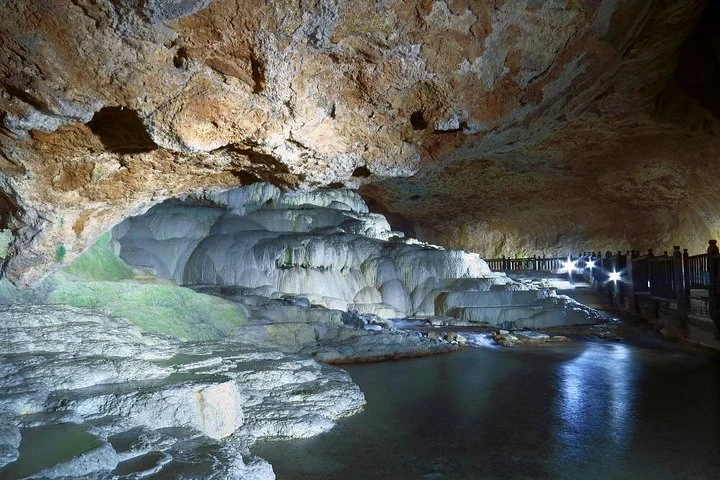
Kaklik Cave illustrates this distinction well. It is a nearby road-connected excursion, not a corner of the town centre. Including it means treating it as a separate journey and checking the conditions of both the route and the site beforehand.
Weather also changes how you get around
The terraces beneath a changing sky are a reminder that Pamukkale is largely an outdoor experience. Regional statistics for Denizli show warmer, drier summers and colder, wetter winters, but these averages cannot predict the weather on a particular day.
Heat, rain or changing conditions may affect your pace, comfort and ability to connect several places. Check the official forecast before setting out and follow the instructions posted at the site once there. Do not infer from the season that the ground will be in a particular condition or that a route will remain open.
The most practical strategy for your itinerary
If the aim is to explore the heritage complex, devote the main journey to Pamukkale and move around the interior using the authorised routes. If you are based in Denizli, the published municipal route may remove the need for a car, once you have confirmed that it is operating that day. If you add Karahayıt, Laodicea or Kaklik Cave, each destination should have its own planned transfer.
The best mobility plan is not the one covering the greatest distance, but the one that reduces fragile connections. Separating the main complex from excursions, checking current services and leaving room for weather or access changes allows you to enjoy the landscape and archaeology without turning Pamukkale into a logistical race.