
A safe visit depends more on preparation than promises
Pamukkale can be visited safely with due care, but no responsible guide should guarantee a risk-free experience. The site combines travertine terraces, wet surfaces, outdoor areas and the ruins of Hierapolis. Each setting requires different precautions, as well as compliance with signs and staff instructions.
Available information does not allow specific areas to be classified as safe or dangerous, or crime rates to be compared. Avoid both alarmism and overconfidence. The most useful preparation is to check the site’s official status and the regional weather forecast, respect access restrictions and adapt the route to each person’s abilities.
If you have an early activity, confirm the operator, pickup arrangements and weather conditions before leaving. A booking alone does not prove that the service can operate that day or that it includes everything you expect.
Travertines: walking slowly also protects the site
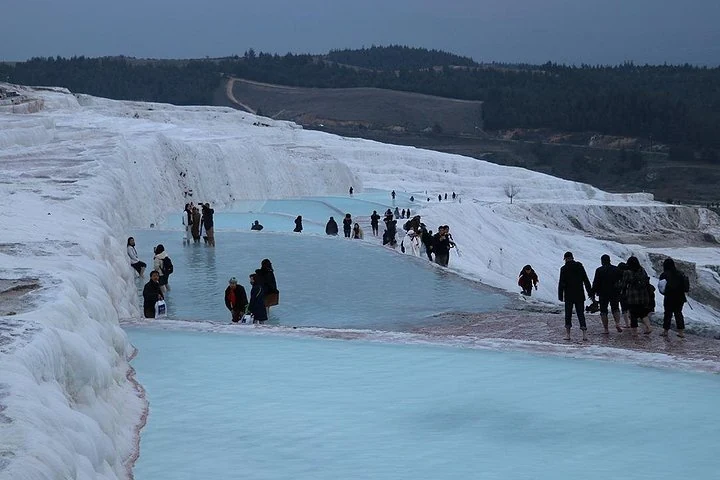
Visitors in a busy pool highlight several essential precautions in Pamukkale: walk slowly, remain within permitted areas and watch for wet surfaces. The white terraces are not an open space where visitors may walk or bathe freely. Conservation requirements restrict general access and reserve specific areas for bathing.
Do not cross barriers or leave the authorized route to get a clearer photograph. The travertine’s white surface may look uniform, but appearance does not reveal where footing is secure, which surfaces can bear foot traffic or which areas remain accessible. Follow the signs even when others do not.
In crowds, leave enough room for everyone to find stable footing and avoid stopping in narrow places. Focus on the ground and site instructions, not only on the view or your camera. Prudent behaviour protects both visitors and the heritage site.
Hierapolis requires a different kind of attention
The visit does not end at the terraces. Hierapolis includes a theatre, necropolis, baths, temples, monumental gates, churches and the Martyrium of Saint Philip, among other documented structures. Moving from water and travertine into an archaeological site changes the conditions: it remains outdoors, and not every area should be assumed to offer equal access or even ground.
Before entering the ruins, consider how far you want to walk and leave enough time and energy to return without rushing. Designated routes do not guarantee an absence of slopes, universal accessibility or unrestricted access throughout the site.
Families should choose an itinerary according to every member’s mobility and need for supervision, without assuming that all sectors will be suitable. The same caution applies to solo travellers: sharing your intended plan and keeping a means of communication available is more useful than relying on a general safety rating.
Weather can change the difficulty of the route
Official Denizli statistics describe warmer, drier regional summers, while December and January are colder and wetter. These are historical averages, not a forecast for Pamukkale or a description of ground conditions during a particular visit.
Check the official forecast before leaving and reassess conditions when you arrive. An outdoor route across travertines and ruins must be adapted to the actual weather, not seasonal expectations. Rain, heat or any weather change can affect the effort required and whether continuing is advisable, even if the site remains open.
Rely only on information you can confirm that day. Do not infer water temperature, access availability, ground comfort or an appropriate visit length from averages.
Permitted bathing does not mean guaranteed bathing
Only areas expressly authorized for bathing should be used in Pamukkale. The appearance of a terrace, pool or spring does not prove that entry is allowed. Do not attribute therapeutic properties to the water or assume that an area used previously will retain the same conditions.
Before entering, check the signs and follow staff instructions. If a sector is closed, the decision is part of site management and must be respected even if it appears passable. Do not move objects, force access or treat a temporary instruction as an invitation to find your own alternative.
Heavy use is recognized as a threat to the site’s conservation. Following restrictions is not a formality: it helps preserve a natural and cultural landscape whose fragility is part of its true value.
Karahayit is a separate excursion
Karahayit is presented as a separate setting from Pamukkale and should be planned accordingly. A thermal bath with handrails illustrates why access and temperature should be checked before entering, but visible features do not guarantee full accessibility, assistance, service quality or consistent conditions.
Confirm directly with the provider which facilities are available and what restrictions apply. Do not automatically transfer rules, access arrangements or conditions observed at Hierapolis-Pamukkale to Karahayit. They are different places, and combining them requires accounting for travel and each location’s operating information.
For residents already familiar with the main site, this distinction makes it possible to choose a specific outing without repeating the tourist route. Regional familiarity, however, does not replace checking access or permit anyone to ignore local instructions.
What to check before entering
The Ministry of Culture and Tourism publishes current information about the site’s status and access. Review it before travelling, because opening hours and conditions must be reconfirmed. Check general closing times, ticket-office hours and access arrangements separately; do not rely on hours remembered from a previous visit.
If travelling from Denizli, the municipal portal lists a connection to Pamukkale, but stops, timetables and services may change. Verify the route that day and prepare a reasonable alternative without assuming night transport, accessibility or particular frequencies.
Private vehicles are restricted within the heritage site except in emergencies. Arriving by car therefore does not mean you can continue driving through the grounds. Plan your route inside according to authorized paths.
Emergencies and a prudent conclusion
112 is the official single emergency number in Türkiye. Save it before your visit, although during an incident inside the site you should also follow staff directions and local notices. Being able to explain where you are and what happened is more useful than improvising under pressure.
Pamukkale does not require fear, but it does require attention. Practical safety depends on recognizing authorized areas, walking carefully on wet surfaces, adapting your effort to actual weather and not treating tourist expectations as guarantees. People who respect the limits gain a fuller understanding of the place: restrictions do not diminish the experience but explain how to coexist with fragile heritage without endangering people or the landscape.