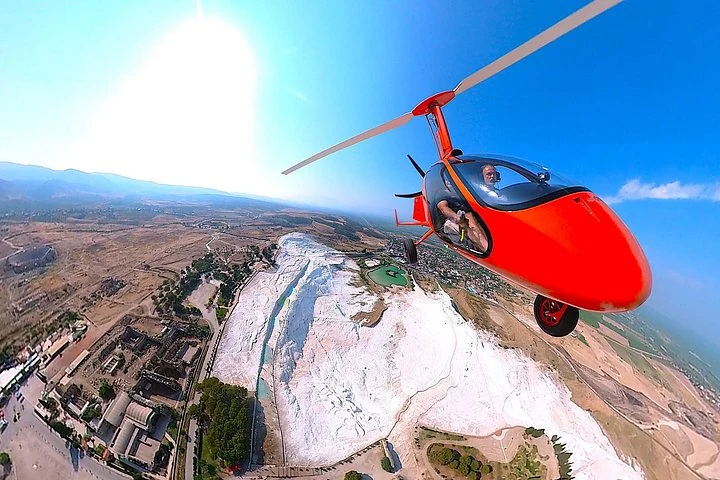
Expecting everything to look like a postcard
Aerial views of the travertines reveal the landscape’s overall form, but they do not guarantee that every accessible corner will match the most widely circulated images. Confusing a panoramic perspective with the experience at ground level creates inaccurate expectations about the site’s appearance, scale and use.
The mistake is to imagine a completely open white surface where everyone may walk and bathe. Pamukkale is a protected property, and conservation requirements determine access. Some areas can be viewed but not entered, while others are governed by specific instructions. High visitor pressure is recognised as a conservation threat, so respecting boundaries is part of the visit rather than an additional obstacle.
Treating every terrace as a bathing area
The terraces are neither one continuous pool nor an area where visitors may move freely. General access is restricted, and bathing is permitted only in designated areas. Crossing boundaries, ignoring signs or assuming that a visible pool is open to visitors damages the heritage and may lead to closures or instructions you did not anticipate.
The sensible response is to follow current signs and staff directions, even if an older photograph shows the place being used differently. Thermal water should not be interpreted as a promise of therapeutic properties. Pamukkale’s value lies in its distinctive combination of nature and history; it needs neither medical claims nor access to every formation to justify a visit.
Confusing the Antique Pool with the travertine pools
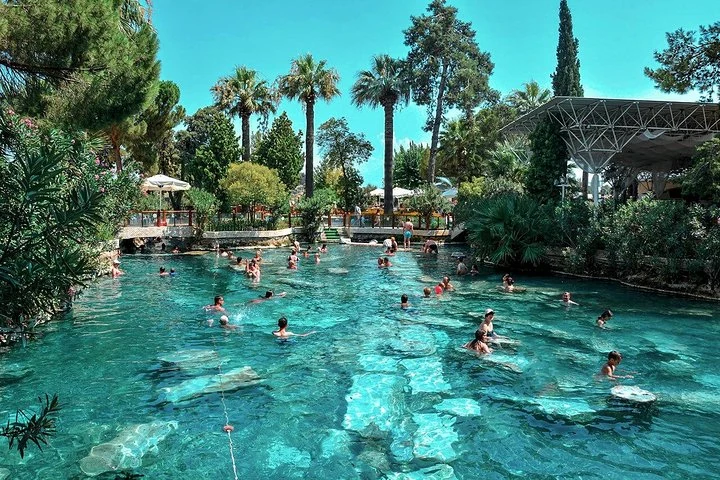
The Hierapolis Antique Pool offers a specific thermal experience within the complex. Precisely because it is an identified pool associated with the ancient city, it should not be confused with the travertine pools or treated as evidence that any water-covered surface is suitable for bathing.
It is also a mistake to plan the entire day on the assumption that this experience will be available under particular conditions. Access, opening and rules must be reconfirmed through the site’s official information. If the pool is essential to your plans, check it before travelling and keep an alternative focused on Hierapolis.
Relying on remembered opening times
Organising the visit around an old screenshot, a review or a memorised timetable is an operational mistake. Official information distinguishes between the site’s general closing time, the ticket office closing time and the closing times for individual entrances. These details may change and should be checked again before visiting.
Arriving before the general closing time does not necessarily leave enough time to buy a ticket or enter through every access point. It is also unwise to leave the archaeological museum or priority structures until a final few minutes calculated too tightly. A sensible plan sets priorities and accepts that one area may require a different decision that day. Anything unconfirmed should be treated as uncertain, not available.
Squeezing in Pamukkale, Karahayıt, Laodicea and Denizli
Official routes present Pamukkale, Karahayıt, Laodicea and Denizli as separate areas. Combining them without checking transfers can turn the day into a sequence of journeys, late arrivals and incomplete visits. Places associated with the same tourist destination do not necessarily form a single site.
For a first visit, the travertines, Hierapolis and the museum make up the most coherent itinerary. Karahayıt, officially identified with its thermal waters, requires a separate decision; Laodicea is another extension, while Denizli has its own urban context. Add them only when there is enough time and the logistics have been reviewed. Skipping one stop may allow you to understand the places you do visit more fully.
Assuming how the transfer will work
A published municipal connection links Denizli, the area around its bus station and Pamukkale, but stops, timetables and services are dynamic. Seeing the real interior of a transfer vehicle may help you picture the journey, yet an image proves nothing about frequency, comfort, accessibility or night-time operation.
Do not build the whole day around an unverified connection. Check the municipal route on the day itself, especially when it must connect with other transport or an entrance subject to closing times. A private vehicle does not solve every mobility issue either: vehicle entry within the heritage property is restricted except in emergencies. Staying in Pamukkale, Karahayıt or Denizli changes the logistics, so choose your base before organising the journeys.
Ignoring the weather and site instructions
Most of the route combines outdoor scenery with ruins. Regional statistics for Denizli indicate warmer, drier summers than winters, which are colder and wetter. These figures are historical averages, not a forecast for a particular day or a guarantee of ground conditions.
The mistake is not choosing a particular season but travelling without checking the official forecast or adapting your priorities. Weather may affect how long you wish to remain outdoors, but it cannot establish whether areas will be open, crowded or accessible. Families and visitors with specific needs should confirm route conditions directly with the site. In an incident, 112 is Turkey’s official single emergency number, but it does not replace instructions from staff.
Visiting without respect for local life
Pamukkale is not a backdrop available for any kind of behaviour. Respect residential areas, people’s rest, private property, shared spaces and the instructions of those working at the site. Basic courtesy, asking before photographing someone and consuming considerately can reduce friction without turning assumed customs into stereotypes.
This means neither entering restricted areas nor treating residents as part of the spectacle. People living in the region may also find a different perspective in a visit focused on Hierapolis, the museum or one specific part of the heritage without repeating the entire circuit. The best final principle is to leave time, check current information and accept the limits. Visiting Pamukkale well is not about covering more, but about looking carefully without damaging what you came to experience.