
Explore the travertines within their limits
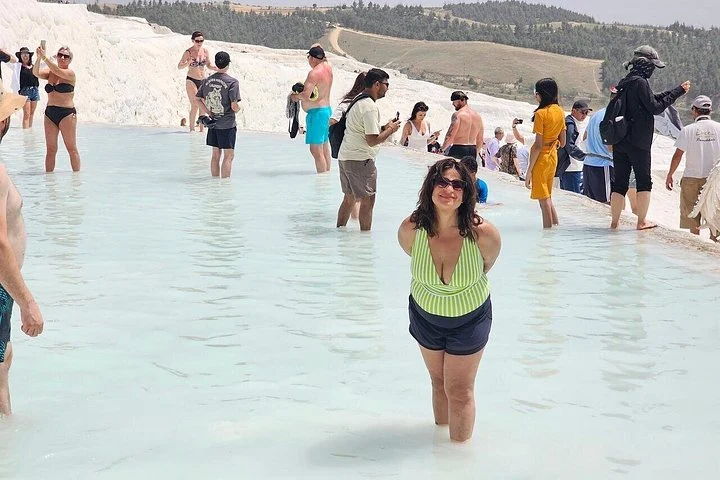
Walking barefoot through shallow water is part of the permitted route across the travertines. It is a simple, physical experience: the water, mineral whiteness and contours of the ground make the landscape feel very different from the view offered by any lookout point. However, not every terrace is open for walking or bathing. General access is restricted for conservation reasons, and visitors should use only the designated areas.
This restriction is not an inconvenience to work around, but part of the reality of the site. UNESCO identifies high visitor pressure as a threat to its conservation. It is therefore important to follow the signs, listen to staff and not assume that a surface visible from the path is open to visitors. Conditions in the authorised areas may vary, so the route should be adapted to what is actually accessible during the visit.
See Hierapolis as a city, not an add-on
Hierapolis deserves more than a quick stop after the travertines. Its documented structures include the theatre, necropolis, baths, temples, monumental gates, churches and the Martyrium of St Philip. Exploring them as parts of an ancient spa city helps explain why Pamukkale has cultural as well as natural significance.
If time or energy is limited, it is better to choose several meaningful points—perhaps the theatre, part of the necropolis and one of the large public structures—than to hurry across the entire site without properly observing it. The route runs through an outdoor setting, and access conditions should not be taken for granted. Official information from the Ministry can be used to check the site’s current status before travelling.
Visit the archaeological museum
The archaeological museum belongs to the main part of the visit and provides a useful pause from the open scale of Hierapolis. Its value lies not simply in adding another attraction, but in restoring a human context to ruins that, when seen in haste, can seem like a scattered collection of stones and façades.
It is also worth considering when the weather makes prolonged time outdoors difficult, although it should not be assumed to solve an entire day of poor weather. Opening and access conditions need to be confirmed. The site’s official portal also mentions an audio guide; if this resource matters to the visit, it is prudent to check whether it is available rather than treating it as guaranteed.
Save a different light for the natural pools
Sunset offers a chance to see the natural pools in a different light and round off the day after Hierapolis. The whiteness of the travertine changes in character as the light loses intensity, so returning visually to the landscape can provide a conclusion rather than merely repeating the initial route.
Seeing balloons above the pools and surrounding landscape is another characteristic scene associated with Pamukkale, but watching them is not the same as booking a flight, nor does it mean they can be promised on a particular date. Anyone wishing to turn that image into an organised activity should separately verify the operation, conditions and restrictions of the exact product. For those who prefer a simple plan, viewing the landscape from permitted areas preserves much of its appeal without adding a commercial activity.
Choose one extension: Karahayıt or Laodicea
Karahayıt and Laodicea appear on official routes as possible extensions separate from the Hierapolis-Pamukkale core. They should not be treated as corners within the same site. Karahayıt is officially identified with its thermal waters and offers a different context from Pamukkale’s white landscape. Laodicea, meanwhile, should be approached as an archaeological section in its own right, not as a brief, improvised detour.
The choice depends on the main interest. Travellers wishing to keep the day focused on ancient heritage may consider Laodicea, while those seeking broader thermal context may prefer Karahayıt. Combining both with the travertines, museum and Hierapolis in one outing can dilute every experience. Transfers, access and current conditions should be checked before deciding.
Add Denizli and Bağbaşı without confusing the scale
Denizli and Bağbaşı also appear in the destination’s official groupings, but they belong to a different territorial extension. Denizli provides an urban context that Pamukkale does not offer in the same way; Bağbaşı can form another distinct part of an excursion. Whether they are worthwhile depends on available time and mobility, not on any obligation to complete a checklist.
For visitors, Denizli can balance monumental heritage with urban life. For residents of the province, the logic may be reversed: rather than repeating only the best-known circuit, it may be more rewarding to select one part of Hierapolis, explore it carefully and combine it on another occasion with one of these nearby areas. Pamukkale then stops being a closed excursion and becomes a territory that supports different visits.
Adapt the plan to the weather and your pace
Much of the experience takes place outdoors. Regional statistics for Denizli show warmer, drier summers than winters, while the colder months receive more rain; these are historical averages, not a forecast for a particular day. Check the official forecast before setting out and follow instructions at the site during the visit.
Families, couples and travellers moving at different speeds do not need to follow the same plan. A slower visit can focus on the travertines, museum and a selection of Hierapolis. Those with a stronger archaeological interest can spend less time contemplating the pools and explore more of the ancient city. If the weather deteriorates, prioritise the museum and avoid committing to too many outdoor extensions, while always confirming that it remains accessible.
A full day without turning it into a race
The most coherent combination brings together the travertines, Hierapolis and the archaeological museum, as all three belong to the same geographical complex and explain complementary aspects of it. Within that framework, each person can choose an emphasis: mineral landscape, urban history, sunset contemplation or archaeological interpretation.
Adding Karahayıt, Laodicea, Denizli or Bağbaşı improves the trip only when there is genuinely enough time to treat them as independent places. Pamukkale rewards attention more than quantity. The memorable part should not be ticking off every stop, but understanding that its terraces and ruins share a history, conservation limits and an experience that requires visitors to watch where they step.