
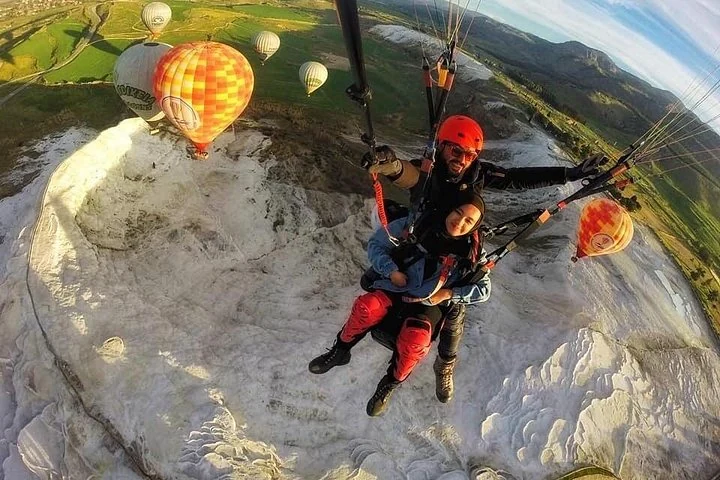
The travertines seen from above
Paragliding above the travertines shows the scale of the white landscape that distinguishes Pamukkale. The suspended figure and the mineral expanse make clear that this is not one photogenic pool, but a broad formation whose impact also depends on the visual continuity of its terraces. Close views reveal individual details, whereas the elevated perspective helps visitors understand the size and unity of the landscape as a whole.
That perspective may suggest complete freedom, yet conservation requirements shape the route on the ground. General access to the terraces is restricted, and visitors may enter the water only in designated areas. No one should assume that every white surface can be crossed or that the whole formation will be available during a particular visit. The panoramic image and the walking experience therefore represent different realities that should not be confused.
An exceptional union of landscape and archaeology
Many destinations possess striking geological formations, while many cities preserve ancient remains. Pamukkale stands apart because both dimensions form a single landscape: calcareous waters shaped the white terraces, while Hierapolis developed above them around a culture closely connected with thermal water. Its distinctiveness lies not merely in placing two attractions beside each other, but in the way the natural formation and the ancient city occupy the same setting.
The theatre, necropolis, baths, temples, monumental gates, churches and Martyrium of St Philip demonstrate that the interest does not end on the hillside. The ruins represent different urban, religious and funerary functions instead of serving as decoration behind the terraces. Ignoring either the landscape or the archaeology means seeing only half of Pamukkale and missing the complexity that supports its recognition as a combined natural and cultural heritage site.
Hierapolis changes the meaning of the visit
Hierapolis adds depth where a hurried visit could remain focused on appearances. The theatre and monumental gates evoke performance and access; the necropolis introduces a funerary dimension; the baths recall the historical relationship with water; and the churches and Martyrium of St Philip reveal the site’s religious continuity. Appreciating this diversity does not require turning the walk into an academic lesson, only allowing the structures to provide context.
For archaeology enthusiasts, these remains can justify the visit on their own. For everyone else, they explain why the waters attracted settlement and different practices over many centuries. The complex requires more curiosity and energy than a panoramic stop: crossed quickly, it may resemble scattered stones; given enough time, it adds a human dimension to the landscape and connects the celebrated white terraces with the lives once organised around them.
Who Pamukkale really suits
Pamukkale is particularly suited to travellers interested in geological landscapes, archaeology or places where nature and culture cannot be separated. It may also appeal to families able to adapt the route to individual stamina, couples seeking a contemplative visit and regional residents returning to examine a particular part of the site, such as the necropolis, theatre or the relationship between the water and the ancient city.
It may be less satisfying for anyone who dislikes heavily visited places, expects unrestricted bathing or wants a purely thermal experience. Nor does it suit a day measured only by the number of attractions completed. Pamukkale rewards observation, context and a pace that allows its different elements to connect, while its impact diminishes when the visit becomes a race between photographic viewpoints or a brief stop limited to its most famous image.
Time, pace and expectations
One day may allow visitors to combine the travertines, archaeological museum and principal structures of Hierapolis when operating conditions permit and the route remains focused on the heritage complex. This is not a universal duration: archaeological interest, personal mobility, weather and available access can all alter the pace considerably. The same plan may feel sufficient for one visitor and rushed for another whose priorities require more time.
The most common mistake is to devote nearly all the time to the terraces and treat the ruins as an afterthought. The opposite extreme also disrupts the balance: crossing the white hillside without understanding its formation or limits of use. Choose priorities in advance and confirm current official information about access and site conditions instead of organising the day around remembered opening times or images that may no longer reflect present circumstances.
Karahayit is a contrast, not central Pamukkale
Karahayit adds thermal waters and reddish terraces that contrast with Pamukkale’s white travertines. It can enrich a longer stay when the purpose is to compare two visually different expressions associated with mineral water and to explore more of the surrounding region. The contrast broadens the journey, but it does not change the separate identity of the main Pamukkale and Hierapolis heritage landscape.
It should not be presented as part of central Pamukkale or automatically compressed into the same visit. Karahayit is a separate excursion requiring consideration of transfers, available time and purpose. Adding it merely to accumulate places may dilute the main experience; it works better when exploring the surroundings is a genuine priority and the itinerary can treat Karahayit as a distinct extension rather than another stop inside the same complex.
Cost, effort and value received
Without relying on changeable figures, a useful budget separates transport, accommodation, admission, meals and optional activities. A short visit may feel unrewarding when travel consumes much of the plan. As part of a regional itinerary or combined with an attentive exploration of Hierapolis, Pamukkale offers a fuller experience. The value received therefore depends on how the journey is organised and how much attention is given to the complete site.
Physical effort also matters. The route runs outdoors through an extensive complex, and visitors should not assume that every area is level or provides identical walking conditions. Before travelling, check the weather, access arrangements and site guidance, especially when mobility requirements need to be considered. The beauty of the setting does not remove these practical demands or mean that every visitor can follow the same route at the same pace.
Pamukkale’s value lies in its complexity
Pamukkale deserves attention because of the exceptional coexistence of the travertines and Hierapolis, not because it promises an unrestricted experience. The fame of the white hillside is understandable because its identity is immediately recognisable, but its more lasting value appears when that image is connected with the ancient spa city, the human uses of the landscape and the need to preserve a fragile environment under visitor pressure.
The destination may disappoint those expecting fully accessible terraces, unrestricted bathing or solitude. Visitors who accept the limits, devote time to the ruins and approach the site responsibly will encounter something rare: a natural landscape that became an urban, spiritual and everyday setting over many centuries. That complexity, rather than one isolated photograph or a list of completed attractions, is what makes Pamukkale special and what makes the journey worthwhile.