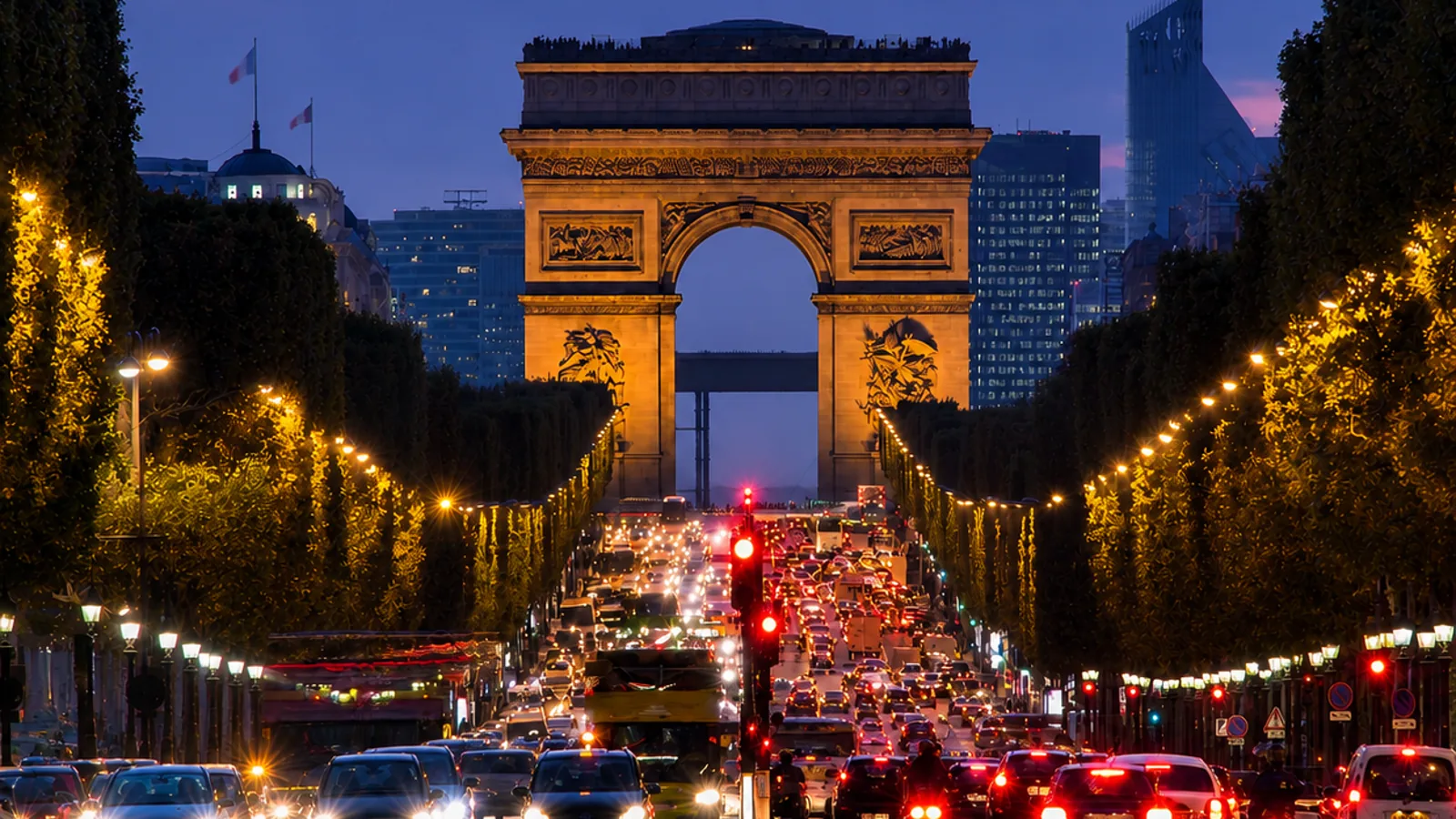


Book Eiffel Tower reserved access with a local host, lift to the second floor and summit option depending on the package. From EUR 29 per person.
View experienceMistakes to avoid in Paris: trying to see everything in just a few days
One of the most common mistakes when visiting Paris for the first time is trying to cram in the Eiffel Tower, the Louvre, Montmartre, Notre-Dame, the Champs-Élysées, the Latin Quarter, Versailles and a Seine cruise as though the city were a checklist.
Paris is best enjoyed in layers. One day can revolve around the Seine and the Île de la Cité; another around the Marais; another between Saint-Germain-des-Prés, the Luxembourg Gardens and a museum. When a trip turns into a chase from one monument to the next, you lose what Paris does best: an old bookshop, the buttery smell of a boulangerie in the morning, a small square at dusk, a brief conversation at a café counter.
Paris is best enjoyed in layers, not as a race from one monument to the next.
Not booking the major sights in advance
Improvising in Paris can be wonderful when it comes to walking, eating or discovering neighbourhoods, but it does not always work for the most sought-after monuments. The Eiffel Tower sells official tickets online for the second floor or the summit, and tickets can be bought weeks ahead. The Paris je t’aime tourist office also runs an official platform for booking attraction and experience tickets.
The mistake is not wanting to visit the Louvre or go up the Eiffel Tower. The mistake is thinking you will be able to decide everything that very morning, especially in spring, summer, on long weekends or during school holidays. To plan a trip to Paris without rushing, book only the visits that really matter and leave free time to breathe the city in.
Book only the visits that really matter and leave free time to breathe the city in.
Staying too far away to save too little
Paris is expensive, and looking for cheaper accommodation is perfectly reasonable. But sleeping too far from the centre can cost you dearly in time, tiredness and transport. Not all suburbs are poorly connected, but it is worth checking the metro, RER or tram links carefully before booking.
Sometimes it is worth paying a little more for a well-connected area rather than losing an hour every morning and another every night. Neighbourhoods such as the Marais, Saint-Germain, the Latin Quarter, Montmartre, Bastille, Opéra or parts of Montparnasse can work well depending on the type of traveller. The important thing is not to sleep “next to the Eiffel Tower”, but to get around Paris easily and return without feeling exhausted.
The important thing is not to sleep “next to the Eiffel Tower”, but to get around easily.
Falling for overly touristy restaurants
You can eat very well in Paris, but you can also eat badly at a high price. Terraces with menus translated into several languages, photos of every dish and waiters calling out from the doorway are usually a sign to think twice before sitting down.
That does not mean every restaurant in a tourist area is bad, but it is worth moving a few minutes away from the most obvious streets. A small neighbourhood bistro, a simple crêperie, a bakery with good sandwiches or a market may leave you with a better memory than a rushed meal beside a monument.
The mistake is thinking Paris guarantees good food on every corner. It does not. You have to choose with a little care, especially near the major landmarks.
Paris does not guarantee good food on every corner: you have to choose with a little care.
Neglecting wallets, phones and bags in crowded areas
Paris is not dangerous in the dramatic sense some people imagine, but it does require attention. The tourist office itself recommends keeping an eye on personal belongings, avoiding carrying large amounts of cash and staying alert to fake petitions or street games used as distractions. The Préfecture de Police also warns of common scams in tourist areas, including fake petitions around places such as Notre-Dame and the Latin Quarter.
The metro, the areas around the Eiffel Tower, Montmartre, the Louvre, major stations and very crowded streets are places where it is wise to keep your bag closed and your phone firmly in hand. You do not need to travel in fear; you simply need not behave as though the city were a risk-free stage set.
You do not need to travel in fear, but you do need to pay attention.
Failing to validate transport tickets properly
Parisian public transport is useful, extensive and usually the best way to get around. But every journey must be validated when entering the metro, RER, bus or tram, and also whenever a reader appears during the journey or at connections. RATP states this clearly in its visitor information.
The typical mistake is thinking that buying a ticket is enough. It is not: you have to validate it. It is also worth checking which transport pass best suits your trip, because spending two days walking around the centre is not the same as travelling between the airport, Versailles, Disneyland Paris and several outlying neighbourhoods.
Buying a ticket is not enough: you have to validate it.
Taking just any taxi without checking that it is official
From the airports, the safest option is to use official taxi ranks or clearly identified public transport. Paris has fixed fares between the main airports and the city: Service-Public lists the official flat rates between Charles de Gaulle, Orly and both banks of Paris.
The mistake is accepting offers from drivers who approach you inside the terminal or outside the official queues. It may seem convenient after a long flight, but it is one of those decisions that often begins with relief and ends with an unpleasant bill.
From the airports, use official taxi ranks or clearly identified public transport.
Visiting Montmartre only for the photo
Montmartre is beautiful at dawn, when the steps are still quiet and the Sacré-Cœur Basilica seems to float above the rooftops. But at peak times it can feel overcrowded, with packed streets, repetitive shops and a certain theme-park atmosphere.
It is worth visiting, yes, but it is better if you walk beyond Place du Tertre, look for side streets and accept that the neighbourhood is no longer the untouched bohemian refuge many people imagine. Montmartre still has charm, but you have to step away from the main flow to find it.
Montmartre still has charm, but you have to step away from the main flow to find it.
Ignoring the silent rules of local life
Paris is not always “friendly” in the easy sense of the word, but it usually responds better when travellers approach it with respect. Saying “bonjour” before asking for something is not a decorative detail: it opens doors. Speaking too loudly in small spaces, blocking pavements to take photos or entering a shop without greeting anyone can be met with coldness.
Local interaction in Paris works with a certain initial distance. It should not always be interpreted as rudeness. Sometimes it is simply the rhythm of a dense, expensive and heavily visited city, where residents live every day alongside millions of travellers. Brief courtesy, the effort to say a few words in French and a little discretion usually improve the experience a great deal.
Saying “bonjour” before asking for something opens doors.
Choosing the wrong time of year
Paris changes profoundly with the seasons. Spring can be bright and beautiful, but also expensive and crowded. Summer brings long days, although some areas fill up and certain small businesses may close for holidays. Autumn is often elegant, with more melancholy light and less tourist pressure. Winter can be cold and grey, but also more intimate, especially if the trip revolves around museums, cafés and short walks.
The mistake is thinking there is only one Paris. There are many. The city you visit in August is not the same one you discover in November, and the experience changes greatly depending on the weather, your budget and each traveller’s tolerance for crowds.
There is not only one Paris: the city changes greatly with the seasons.
Underestimating fatigue
Paris involves more walking than it seems. Distances on the map are deceptive, museums are tiring, metro stairs add up and the cobblestones take their toll. Wearing uncomfortable shoes for the sake of style is almost guaranteed to be a bad decision.
A good traveller plans not only what to see, but when to stop. An unhurried coffee, a bench in the Luxembourg Gardens or an afternoon with no tickets booked can save the trip. Paris does not necessarily reward the person who rushes the most, but the one who knows how to look.
Plan not only what to see, but when to stop.
Expecting a perfect city
Perhaps the biggest mistake is arriving in Paris expecting a fantasy with no noise, no occasional rubbish, no waiting, no high prices and no misunderstandings. Paris can be romantic, yes, but also brusque. It can give you one of the best afternoons of your life beside the Seine and, the next day, test your patience in an overcrowded station.
It is worth it for those who enjoy cities with history, art, gastronomy, architecture and intense urban life. It can disappoint those looking for absolute calm, constant ease or a perfectly polished experience.
Paris does not need to be perfect to be unforgettable. In fact, part of its power lies in that mixture of beauty and roughness: elegant shop windows beside chaotic stations, golden domes under grey skies, curt waiters serving excellent coffee, monumental avenues and alleyways where the echo of another era still seems to linger.
Travelling well in Paris means not demanding that it be a dream. It is enough to allow it to be a real city.
Paris does not need to be perfect to be unforgettable.