 Activity on TourBookGo
Private 2-hour Reykjavik Walking Tour | TourBookGo
Explore Reykjavik on a private 2-hour walk for 1 to 15 travellers, with a city centre meeting point and an adaptable route. Check details and book on Viator.
Illustrative photograph; exact location unverified.

Getting around Reykjavik is easier when you separate three needs: exploring the centre, reaching other parts of the capital and arranging trips beyond it. Walking may be enough for much of a city visit; buses and cars suit other distances. The right choice depends on your address, your plans and the conditions on the day.
The image gives urban context for choosing a base; it identifies no booked accommodation and establishes no facilities, price or accessibility. Illustrative photograph; exact location unverified.
Find accommodation on BookingThe compact centre brings Hallgrímskirkja, Tjörnin, Harpa and the Old Harbour within reach of one another. Their proximity makes walking routes possible, but it is worth grouping visits by area instead of returning to the same place after every stop. The hill where Hallgrímskirkja stands is also a reminder that a city walk can involve changes in elevation.
If this is your first visit, locate those landmarks and your accommodation on a map before setting out. Then choose which stretch you want to walk. A central address can make this easier, although the word “centre” never replaces checking the actual route, especially if you have luggage, are travelling with children or need to limit physical effort.
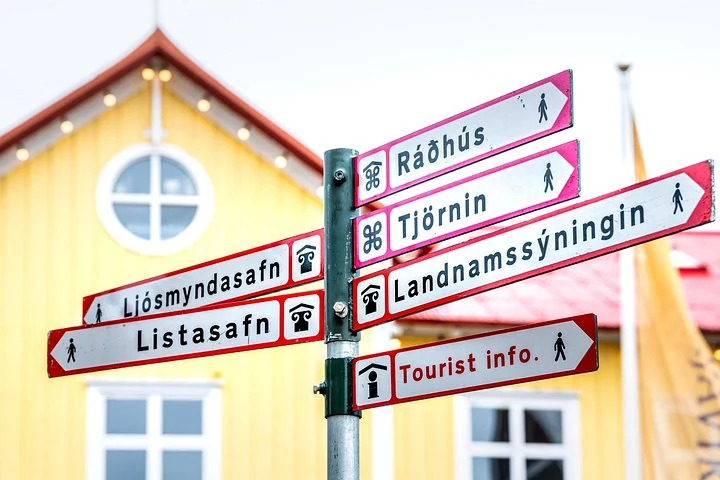
The pedestrian signs in the image have arrows pointing towards Ráðhús, Tjörnin and other places. These names help explain the difference between recognising a destination and knowing how to reach it. Illustrative photograph; exact location unverified. The signs do not establish where the photograph was taken or confirm a stop, a public service or an included transfer. To find your way while walking, compare the name you are looking for with your position and the entrance you need. If you have booked an activity involving a vehicle, pedestrian signs do not identify its meeting point either: that information must appear in the booking conditions.
Strætó lets you search for journeys by origin, destination, date and time, and check timetables and service disruptions. This combination matters more than memorising a route number: an option that works for your outward journey may not suit your return or an appointment on another date.
Enter precise addresses and check any sections you need to walk as well. If transfers are involved, consider how convenient they are for your group and how much time you have before a booked activity. The bus is worth comparing when your interests extend beyond the compact centre; its usefulness depends on the actual journey, without assuming frequent services or immediate connections.
Klapp is used for city buses in the capital area. Keep that coverage separate from regional and airport services, whose conditions you need to check individually. Do not assume one ticket covers every journey that starts or ends in Reykjavik.
Strætó’s information includes single tickets and passes for a set period. To choose, count the journeys you actually expect to make and review the applicable conditions. If you spend much of your stay walking, a longer pass does not necessarily save money. Also check how to buy and use your chosen ticket before planning your day around it.
Route 55 connects KEF airport with the capital area, but that connection does not guarantee a suitable option for every flight. Search for the journey on your specific date and at your arrival time, and check where it ends in relation to your final destination.
Treat arrival as a sequence: leave the airport, take your chosen transport and complete the final stretch to your address. With luggage or after a long journey, that route deserves consideration in its own right. Apply the same approach to the return: a convenient arrival option may not suit your flight home. Check both journeys before deciding.
The image shows an urban scene with a black van in front of Harpa’s glass façade. It does not prove that a transfer is available there or that the vehicle belongs to a particular activity. Recognising the building is not enough to identify a pickup.
When booking an excursion, distinguish between visiting Harpa and going to the location specified by the operator. Confirm the address, pickup conditions and route from wherever you are. Do not assume the vehicle will collect passengers from every accommodation address. A regional excursion has its own logistics even when it leaves from the capital; its booking conditions determine what transport is included and where the service begins.
For a programme focused on the centre, compare what a car would offer with walking and taking the bus. Include collecting the vehicle, the rental conditions and parking options at each address in that comparison; do not assume parking will be available or free.
If you want to leave the capital, define your route first. A car can give you independence, but also means taking responsibility for driving and checking conditions along the route. Weigh that responsibility against an excursion with confirmed transport included. You do not need one solution for your entire stay: city days and regional outings may call for different arrangements.
Summer brings very long daylight hours; in autumn, days shorten and darkness returns. In winter, clothing and footwear must suit the actual street conditions. These changes affect which journeys are sensible to make on foot.
Before committing to an outdoor trip, check the relevant official information, including weather warnings, access information and volcanic alerts when they affect your route. SafeTravel provides preparation resources and alerts. If you have mobility needs, check the specific route and service: a photograph, a short distance or proximity to the centre does not establish accessibility or the absence of obstacles.
If you are visiting, choose accommodation with all your journeys in mind: walks, arrival from KEF and meeting points. A useful base reduces inconvenient journeys for your programme, rather than necessarily being the closest to a single attraction.
If you live in the city, compare a new plan with your usual connections and check the return particularly carefully; knowing the neighbourhood does not mean knowing the service on that date. In either case, decide according to each journey’s purpose. Walking lets you explore the centre; buses can connect other interests, and a car should justify the responsibilities it adds.
Reykjavík: Each booking’s conditions determine which transport is included.
Activity on TourBookGoExplore Reykjavik on a private 2-hour walk for 1 to 15 travellers, with a city centre meeting point and an adaptable route. Check details and book on Viator.
 Activity on TourBookGo
Explore Reykjavik’s history with a local English-speaking guide on a 150-minute shared walk. Check the itinerary, conditions and booking on Viator.
 Activity on TourBookGo
Explore the Golden Circle and Kerið by minibus with an English-speaking guide and up to 18 travellers. Check pickup, terms and dates on Viator.