 Activity on TourBookGo
Reykjavik Food Walk: Icelandic Food Walking Tour
Explore central Reykjavik with Icelandic tastings and an English-speaking guide. A shared 3-hour walk starting at Harpa. Check details on Viator.
Choose between the centre and Old Harbour to suit your route. Illustrative photograph; exact location unverified.

Fish, lamb soup, hot dogs, pastries and skyr desserts are possibilities, not a universal menu. Decide whether to fit in a meal or make it part of the trip.
The image gives urban context for choosing a base; it identifies no booked accommodation and establishes no facilities, price or accessibility. Illustrative photograph; exact location unverified.
Find accommodation on BookingThe compact city centre lets you link Hallgrímskirkja, Tjörnin, Harpa and the Old Harbour in one urban walk. On a first visit to the capital, choose where to eat after arranging those stops. That avoids crossing the city again just to seek out a dish that may not be a priority.
Before sitting down, decide whether you want a quick stop or a meal that needs more time. If you have a visit or activity booked afterwards, ask about service and allow enough time for that commitment. Being close on the map does not mean any restaurant will fit between two plans.
The Old Harbour works well if you want your meal to form part of a walk around the harbour. The centre makes more sense when your day revolves around its streets and cultural sights. Neither setting guarantees better cooking: the surroundings and the food are separate choices.
Do not assume an address by the harbour guarantees local fish, or that a dining room away from the sights will cost less. Check the specific offering. If you choose the harbour for its outdoor walk, adapt that stretch to the day's conditions; your table does not commit you to the entire walk.
Seafood and lamb soup are among the city's culinary reference points. They are starting points for reading a menu, not dishes you have to order. If an ingredient interests you, ask how it is prepared: a dish's general name tells you less about the experience than its ingredients and preparation.
For a meal focused on discovering flavours, choose whatever sparks your curiosity. You do not need several traditional dishes to justify the visit. One preparation you enjoy and understand offers more than a succession of obligatory samples. Nor should you assume every ingredient is Icelandic without confirmation from the establishment.
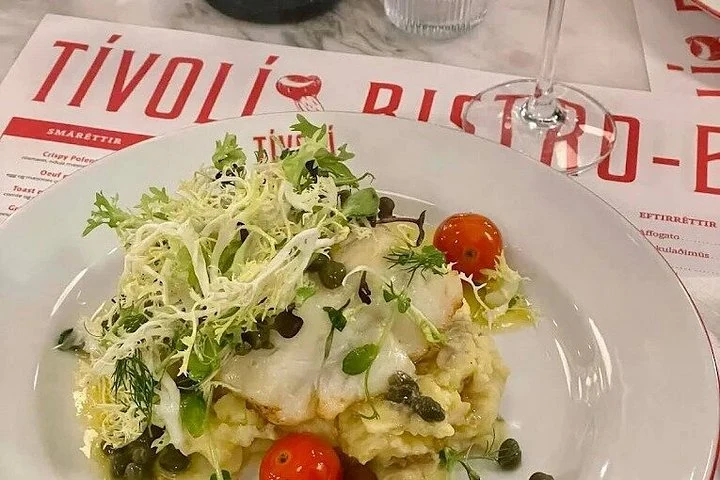
The illustrative scene shows a plate with pale-coloured food, green leaves and tomatoes on paper from an eatery. It invites you to look closely at what arrives at the table, although those details cannot identify the recipe, allergens or establishment. Illustrative photograph; exact location unverified.
If you are considering a food experience, decide whether the explanations or the range of bites interest you more. Confirm which tastings are included and what substitutions are possible. The image does not establish the menu for a future date, and attractive presentation alone cannot tell you whether the experience suits you.
Hot dogs offer another way to explore Reykjavik's culinary reference points, especially if you prefer a meal built around a single item. Do not choose one assuming every version has the same ingredients or toppings: check what you are ordering and whether it will satisfy your appetite.
The image of two people in warm clothing holding hot dogs outdoors evokes this informal meal, without identifying a stand or establishing where it was taken. Illustrative photograph; exact location unverified. When choosing between eating outside and finding an indoor table, consider the actual conditions and what the group needs.
Pastries and desserts with skyr can give a sweet break a place of its own. If curiosity is your reason for trying something, decide whether you would prefer a pastry or a dessert after your meal. You do not need both to feel you have experienced the local food.
Skyr may guide your choice, but seeing it in a dish's name does not describe the whole preparation. Ask about the other ingredients whenever they matter to you. A sweet stop works best when it answers your appetite, rather than being added automatically to every meal.
To spend less, compare options that meet a similar need. A snack and a full meal are not equivalent alternatives if you then need to order again. Check the current menu and consider everything you will consume, including drinks and any side dishes you choose.
Location is no substitute for that comparison. Being near a well-known sight does not prove a business is a tourist trap. Clarity is more useful: what is served, what each option includes and how much your order will cost. If anything is unclear, ask before ordering.
If you have allergies or dietary restrictions, choosing starts before you sit down. Ask about ingredients and how the establishment can accommodate your specific needs. A photograph, a dish's name or a brief description cannot confirm that a preparation is suitable.
In a group, check everyone's options before committing to a table or tasting. If someone needs an adjustment, confirm directly that it is available. Avoid choosing in a rush of enthusiasm and leaving that conversation until later: understanding the limits of the offering helps you find a meal everyone can share with peace of mind.
If you are visiting, leave room for a meal that reflects your curiosity and arrange the others around your route. This lets you explore some of the city's culinary reference points without turning every stop into an exhaustive search or displacing the visits that matter most to you.
If you live in Reykjavik, try changing your criteria: choosing an ingredient or preparation you have yet to discover may offer more than repeating the circuit between the centre and the Old Harbour. Ask about the specific offering and choose what you feel like eating. Something new may also come from how you read a familiar menu.
Reykjavík: Confirm the included tastings and possible substitutions before choosing.
Activity on TourBookGoExplore central Reykjavik with Icelandic tastings and an English-speaking guide. A shared 3-hour walk starting at Harpa. Check details on Viator.
 Activity on TourBookGo
Explore Reykjavík with an English-speaking guide and up to 8 travellers. Taste 9 local foods and 4 local beers over 180 minutes. Check Viator.
 Activity on TourBookGo
Try Icelandic food and beer with historical commentary on a shared 240-minute Reykjavik walk led in English. Check details and book on Viator.