 Activity on TourBookGo
Córdoba, Setenil and Ronda day trip from Seville with guide
Book a Córdoba, Setenil and Ronda day trip from Seville: 13 hours with guide, air-conditioned transport and optional Mosque-Cathedral entry.
Knowing how to get around Seville makes the trip smoother: the city is wonderful on foot, but the best plan combines walking in the centre, public transport for medium distances and avoiding the car unless it is truly necessary.
How to get around Seville depends on more than distance: heat, your neighbourhood and the pace of your trip all matter. The historic centre invites you to wander among whitewashed façades, orange trees, shady squares and narrow lanes where time seems to slow down. However, the city also has intense heat, sprawling neighbourhoods, stations that are somewhat removed from certain tourist areas and periods — Holy Week, the April Fair, spring weekends — when choosing the wrong transport can turn a pleasant stroll into a test of patience.
Compare locations and options to find a base that suits your trip. Booking.com confirms current availability and pricing.
Find accommodation on BookingTo visit the Cathedral, the Giralda, the Royal Alcázar, Santa Cruz, the Archive of the Indies, Plaza de España, María Luisa Park, Triana or the banks of the Guadalquivir, walking is still the most beautiful way to discover Seville. The city reveals itself in the details: the scent of orange blossom in spring, the sound of a metal shutter being raised as a tavern opens, the golden reflection of the river at sunset.
But you have to be realistic. In summer, especially during the middle of the day, too much walking can spoil the experience. Seville is not the same at four in the afternoon in July as it is at eleven in the morning in October. In the hotter months, it is best to plan longer visits early in the day, save afternoons for indoor sights or rest, and use public transport in Seville for journeys you would walk without a second thought at another time of year.
Seville’s city bus network, run by TUSSAM, is one of the most practical ways to get around outside the monumental heart of the city. The City Council provides information on routes, timetables, fares, sales points and route planning within its mobility services.
The Seville city bus is especially useful if you are staying outside the centre, heading to areas such as Nervión, Los Remedios or La Macarena, or need to connect with stations and less touristy neighbourhoods. Its drawback is that, for a first-time visitor, some routes can feel less intuitive than walking or taking the tram. It also depends on traffic: at rush hour, a short journey can take longer than expected.
My advice: use it for specific journeys, not to improvise your whole day. Check the route before setting off and avoid relying on the bus if you have a reservation at a very tight time.
Seville’s metro does not cover the entire tourist city, but it is convenient for certain journeys, especially if you are staying in or moving around areas connected to Line 1. The official Seville Metro website offers a map, journey planner, next-train information, timetables and fares.
It is not the form of transport you will use most if your trip focuses only on the historic centre, Santa Cruz, Triana and the monumental area. For that, you will probably walk more. But it can be very convenient for reaching Nervión, Los Remedios, some residential areas or for combining with other forms of transport.
Its main advantage is predictability: it does not depend on traffic and is usually easier to understand for those unfamiliar with the city. Its limitation is obvious: a single line cannot solve every journey in Seville.
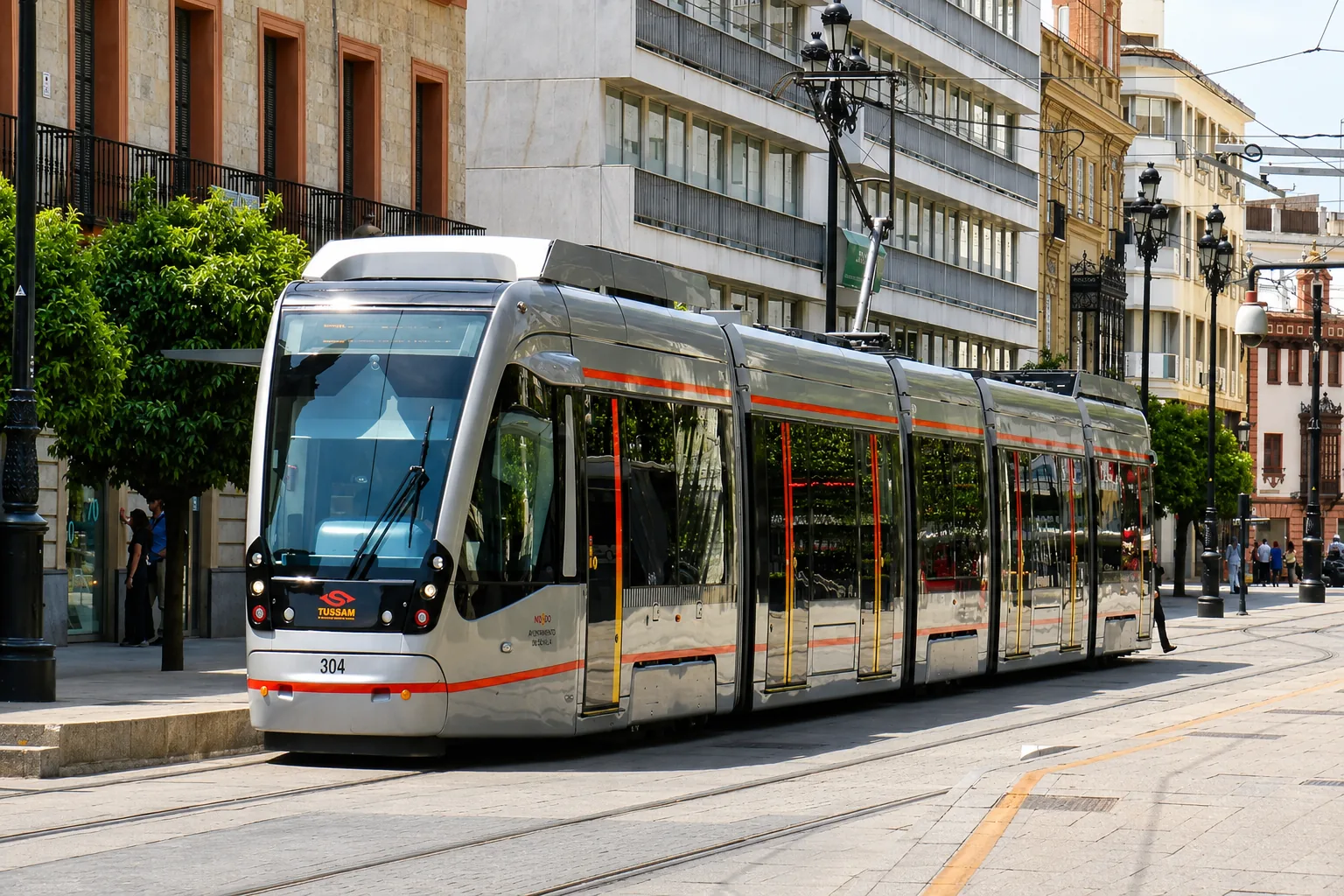
Seville’s tram, known as Metrocentro, works as a practical connection along the central axis. It is not a large tram network, but rather a stretch designed to make journeys easier within a very specific part of the centre and to link up with other forms of transport. Official information includes it among the city’s public transport options.
It can be useful if you want to avoid walking in the sun or need to move between nearby points without getting tired. Do not expect it to solve your whole trip: it is more of a convenient support than a complete solution.
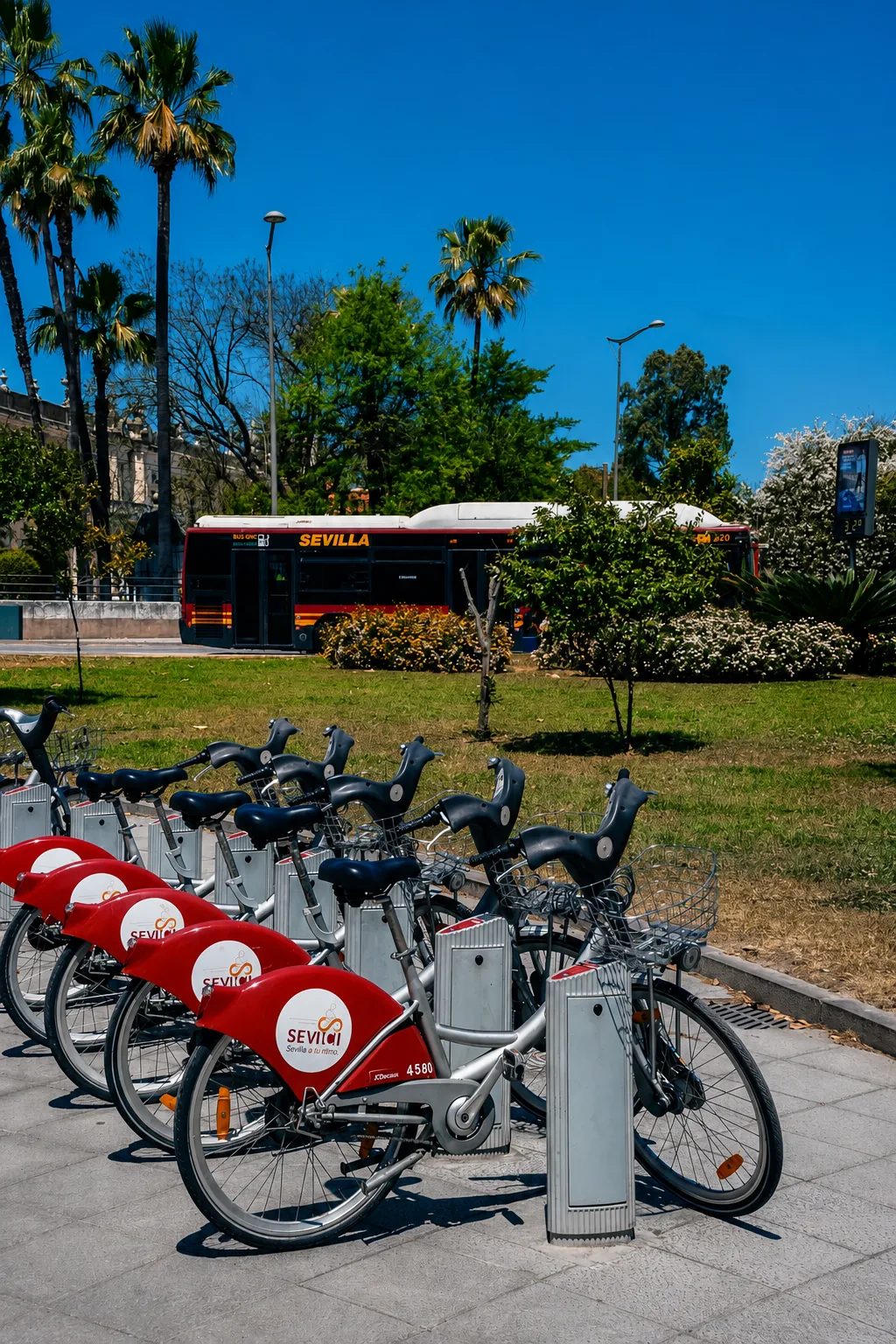
Seville is one of the Spanish cities where cycling makes the most sense for visitors. It is relatively flat, has a network of cycle lanes and offers the Sevici urban bike-sharing system. The City Council’s Bicycle Office provides information on the cycle-lane network, and Sevici offers different passes for occasional and frequent users.
Cycling works very well for riding along the Guadalquivir, connecting the centre with Triana, reaching Plaza de España or moving along wide avenues. That said, it is not always ideal inside the narrowest parts of the old town, where there are busy pedestrian streets, uneven paving and corners where it is better to go slowly.
You also have to consider the heat. Cycling in Seville in May can be delightful; doing it at midday in August, much less so.
A taxi in Seville or ride-hailing service can be a good option when arriving with luggage, returning late, getting around on very hot days or travelling between places that are poorly connected. It is not necessary for exploring the centre, and in very busy areas it may be less practical than walking a few minutes to a more accessible avenue.
During major events, such as the April Fair or Holy Week, traffic and road closures can greatly affect journeys. On those dates, it is best not to assume that a car will be able to drop you exactly where you want to go. Special mobility arrangements usually reinforce public transport and restrict access in certain areas.
A car is useful if Seville is part of a wider route through Andalusia, if you are going to visit villages, beaches or natural areas, or if you are staying on the outskirts. But for getting around Seville without a car inside the city, the alternatives are usually easier, cheaper and less stressful.
The centre has narrow streets, restricted traffic, difficult parking and areas where restrictions may change depending on regulations or time of day. Seville also has a Low Emission Zone in designated areas, with access restrictions for certain vehicles from Monday to Friday at specific times.
If you arrive by car, the most sensible option is usually to leave it in a car park and forget about it during your city visit.
To connect Seville airport to the city centre, TUSSAM’s special airport line runs to Plaza de Armas and other stops along the route. TUSSAM itself publishes updated timetables for this line, so it is worth checking them before travelling, especially if you arrive very early or very late.
If you are travelling with lots of luggage, small children or arriving at night, a taxi may be worth it for comfort. If you are travelling light and want to save money, the airport bus is usually a reasonable option.
In Seville, many distances look short on the map, and they are, but fatigue depends heavily on the weather. Between the Cathedral, Santa Cruz, the Alcázar and the Archive of the Indies, you hardly need transport. You can happily walk from the Cathedral to Triana, crossing the river and entering another Seville, more popular and local in feel. Plaza de España can also be reached on foot from the centre, although in summer it can feel tiring.
Santa Justa, the main train station, is somewhat farther from the monumental core. You can walk there if you do not have luggage and enjoy walking, but for most travellers it will be more comfortable to use a taxi, bus or a combined connection depending on where they are staying.
The first mistake is underestimating the heat. Do not plan Seville as if it were a northern European city. In summer, a thirty-minute walk in the sun can feel much longer.
The second mistake is staying far from the centre based only on saving money, without properly checking the connection. It may be worth it, but not always. If every departure and return requires too much logistics, you will end up paying the difference in time and tiredness.
The third mistake is renting a car to visit Seville. If you are only going to be in the city, you do not need one. If you need one for a later route, try to pick it up at the end of your urban stay.
The fourth mistake is not adapting your journeys to events. Holy Week, the April Fair, football matches, concerts and local festivities can change road closures, timetables and taxi availability. On those dates, walking and using public transport with extra time is usually the smarter option.
Seville is comfortable for travellers who enjoy walking, couples who want to wander without rushing, visitors interested in heritage, food and urban life, and people staying in the centre or near a good transport connection.
It is also well suited to weekend breaks, because many essential sights are relatively close to one another. You do not need to master a complicated network to enjoy it.
It can be less straightforward for travellers with reduced mobility, especially in some old streets with uneven paving, narrow pavements or heavy pedestrian traffic. It can also be tiring for families with small children in summer, older travellers during heatwaves or visitors trying to cover too many neighbourhoods in a single day.
It is not a difficult city, but it is a city that demands the right rhythm. Seville is best enjoyed when you do not treat it as a checklist of monuments, but as a sequence of walks, pauses and shade.
For most travellers, the ideal formula is simple: walk around the historic centre, use the tram or bus for occasional journeys, take the metro if your accommodation or destination is close to a station, cycle in spring or autumn, and use taxis for arrivals, nights or extreme heat.
The car is best kept far from the centre.
Getting around Seville should not feel like a race. The city has something theatrical about the way it appears: an unexpected square, a church open in the middle of the afternoon, a terrace beneath awnings, a bridge over the Guadalquivir when the light turns copper. Choosing well how to move around does not just save time. It also allows Seville to reveal itself without exhausting you before you have had the chance to understand it.
Complete this transport guide with experiences in Seville that fit easily into your journeys and routes around the city.
Activity on TourBookGoBook a Córdoba, Setenil and Ronda day trip from Seville: 13 hours with guide, air-conditioned transport and optional Mosque-Cathedral entry.
 Activity on TourBookGo
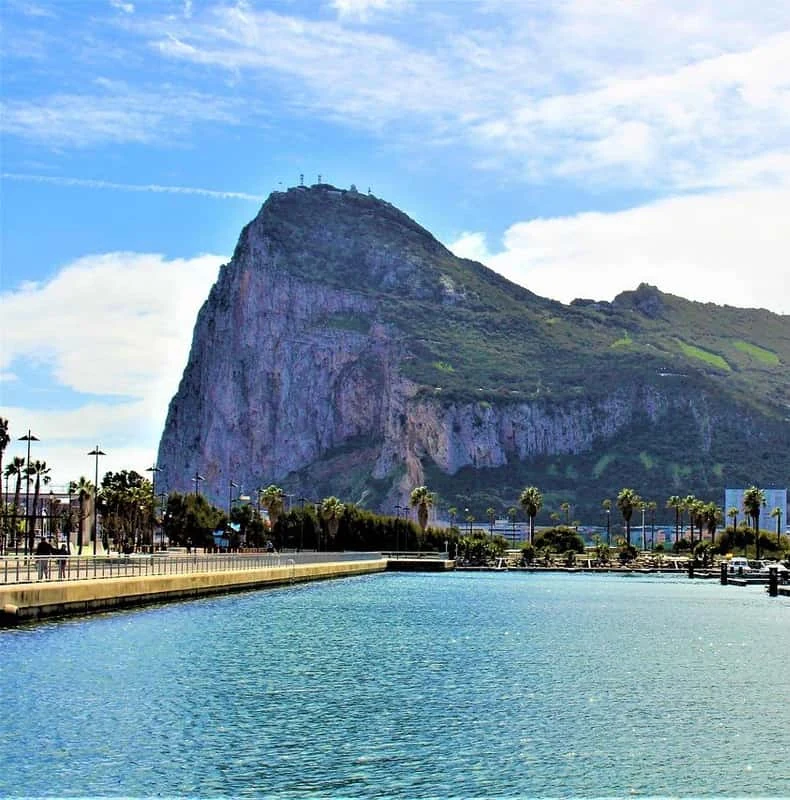
Book a 10-hour Gibraltar day trip from Seville with bus transfer, assistance and five hours of free time. Check price, duration and inclusions.
 Activity on TourBookGo
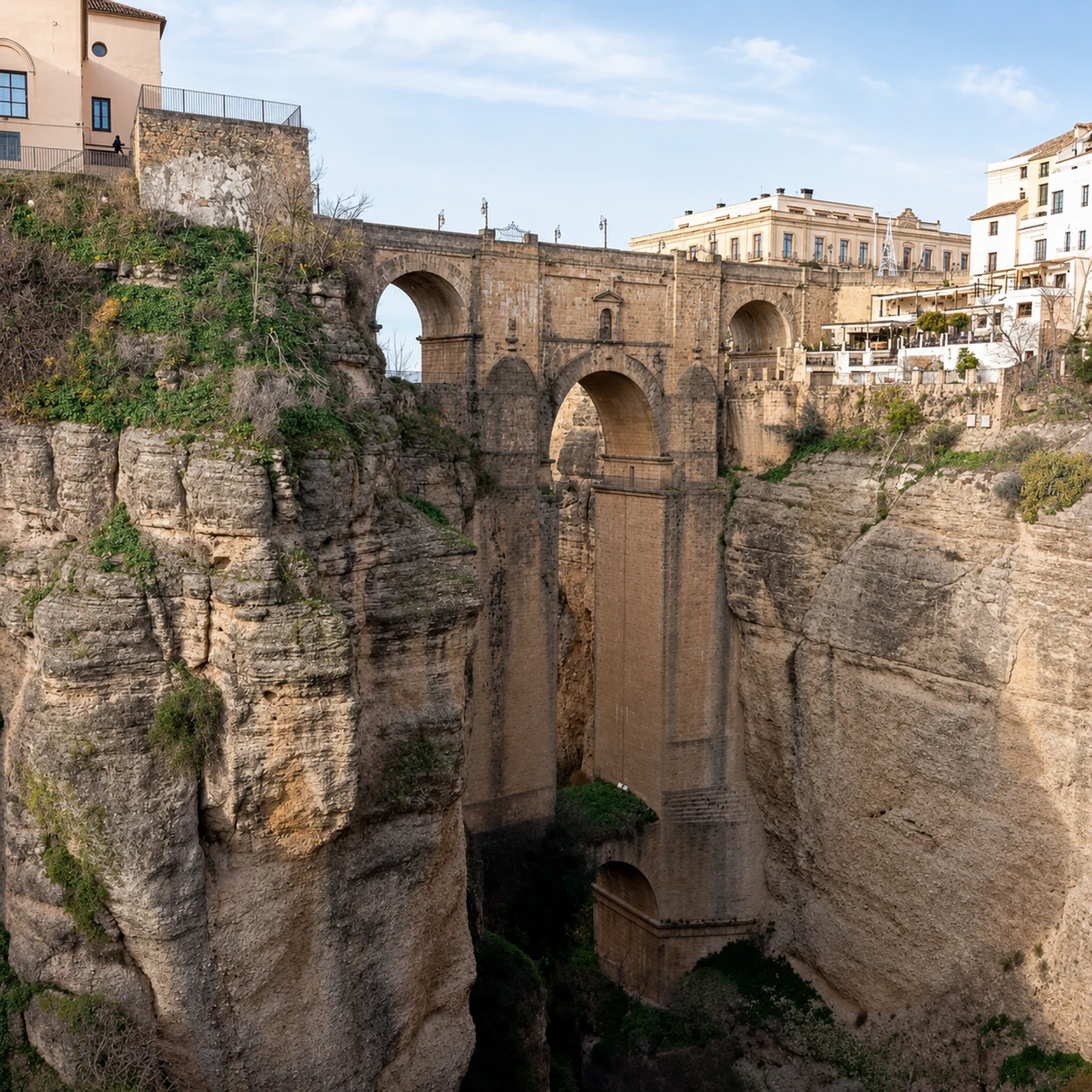
Book a Setenil and Ronda day trip from Seville with transport, free time, optional guided tour and flamenco in Ronda.