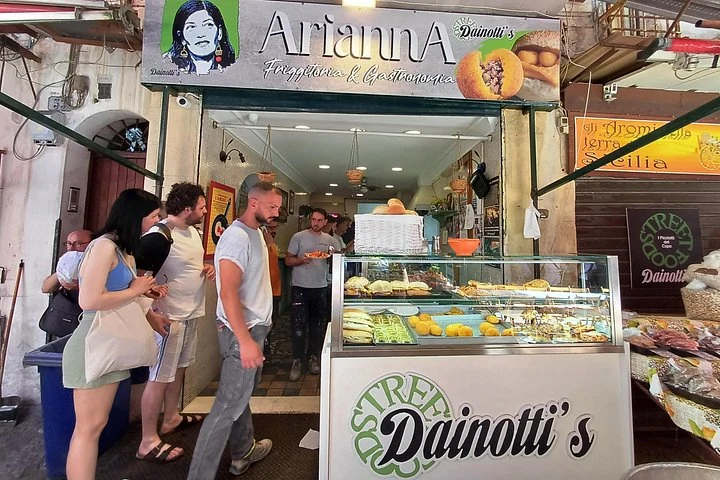
Palermo: fruit, markets and street food
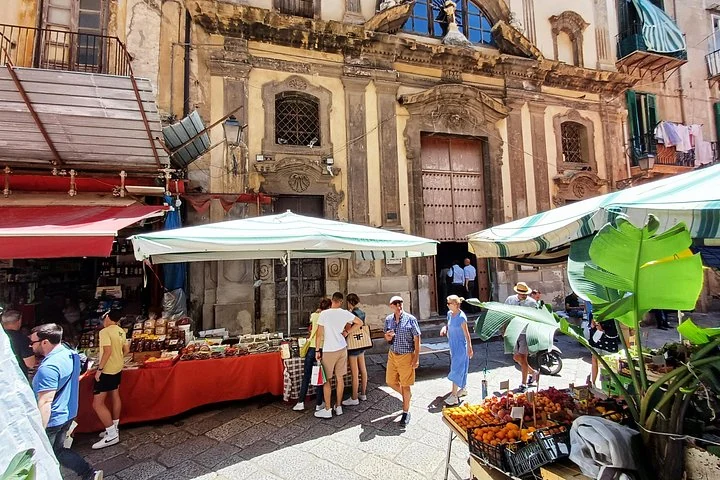
Ballarò, Capo, Vucciria and Borgo Vecchio are part of Palermo’s market tradition. Fruit stalls bring an everyday dimension to a food-focused visit: you can browse produce and choose something to buy alongside prepared food. You need not visit every market to understand this connection between shopping and eating.
Traditional panelle use chickpea flour; crocché, also called cazzilli, use potatoes. These are useful pointers when choosing fried snacks, although you should confirm each establishment’s preparation. Panino con la milza belongs to the offal sandwich tradition: knowing this before ordering avoids a surprise if that cooking does not appeal.
For a first visit, choose one market and a speciality that interests you. Making every stop compulsory can leave little appetite to appreciate what you eat.
Catania: separate the fish market from the meal
La Pescheria lies behind Catania’s cathedral. It offers context for the city’s fish culture, but visiting a market and choosing a restaurant are separate decisions. Nearby stalls do not establish the origin of food served at surrounding tables.
If you want fish, ask how it is prepared and what the dish includes before deciding. For street food, crispelle with anchovy or ricotta and scacciata offer other local options.
Choose according to what you feel like eating, rather than proximity to a famous place. The market can still be a food-focused visit even if your main meal centres on something else.
Messina: try a speciality of its own
Pidone is among Messina’s street-food specialities. It broadens your perspective: Sicilian food is about more than repeating the same snacks in every city.
You will also encounter the names arancina and arancini within the regional tradition. A name offers guidance, but does not identify a particular filling or replace a product description.
If your route includes Messina, a local speciality can give that stop a focus. You need not make a special detour or assume every establishment serves it. Asking what they prepare is more useful than arriving with a fixed order.
Ortigia: buy produce or find a meal
In Siracusa, Ortigia’s market is near the Umbertino bridge. This reference helps you include it in your route without confusing it with other places on the island.
Before buying, decide how you will use the products. With a kitchen, you can look for meal ingredients; when passing through, consider what is practical to carry and eat. Impulse purchases make little sense without somewhere to store or use them.
If you want a sit-down meal, check that your choice provides one. A market can offer context and worthwhile purchases without supplying lunch. Separating these expectations avoids choosing while hungry and poorly informed.
Marsala: a meal in town or a wine tasting
Via XI Maggio has bars, bakeries and restaurants in central Marsala. It provides a starting point for comparing establishments: a quick stop and a sit-down meal require different offerings.
Alagna winery offers visits with Marsala wine tastings and food accompaniments. This suits an interest in wine, but should not be equated with a restaurant or a full meal.
Before booking, confirm the available format and accompaniments. The winery states that there is no direct public transport, so you must arrange your own journey. If eating in the centre is your priority, a winery visit adds logistics that may not be worthwhile.
Montevago: explore olive oil with a purpose
Amodeo’s Farm offers a farm visit and olive oil tasting in Montevago, in the province of Agrigento. This experience takes place in its own setting, not in central Palermo or Marsala.
It may suit you if you want to devote part of your trip to a product and its production. If you simply want lunch, first confirm what the activity includes: an olive oil tasting does not establish that a restaurant service is available.
The decision depends on your interest in learning. Check booking arrangements and conditions, then fit the visit into a coherent local route, rather than making a separate journey based on unclear expectations.
Cefalú: make room for a shared meal
Near Cefalú, a table set for a meal suggests another side of food: sitting together, sharing and giving a meal its own place in the day. This setting does not establish that there is a cooking class, a particular menu or a bookable activity.
If you want a shared meal, compare what is actually offered. For a couple, the table arrangement may matter; for a family, options everyone wants to eat may be important.
Decide how central this meal should be. A table can be the focus of a gathering, but its surroundings alone do not guarantee good cooking.
Spend less without eating on autopilot
Street food, bakeries and restaurants serve different kinds of meals; there is no basis for saying any category is always cheapest. Compare the displayed cost with the quantity and your needs.
Before ordering, clarify what is included and charged separately. A succession of small snacks may replace a meal without your having decided that it should.
To control spending, choose the experiences that interest you most and avoid buying just to complete a list. A clear menu and specific explanation help more than a vague promise of authenticity.
Choose according to your needs and connection to the island
A traditional recipe does not guarantee the composition of what is served. If you have dietary requirements, confirm ingredients and preparation directly; do not assume panelle are suitable because of chickpea flour, or cazzilli because of potatoes.
For visitors, choosing one culinary point of interest at each stop provides variety without extra journeys. Residents can refresh an outing by changing its purpose: shopping to cook, meeting a producer or trying an unfamiliar speciality.
Eating well in Sicily means adjusting expectations. Sometimes you want fried food; sometimes a table or a tasting. The most satisfying choice will suit your appetite, your needs and the time you want to spend.