Mistakes to avoid in New York: how not to let the city swallow your trip whole
Knowing the mistakes to avoid in New York can transform your trip: the city can feel like a film playing all day and night, but it can also exhaust you, disorient you and drain your budget if you arrive without understanding its rhythm.
The mistakes to avoid in New York often begin before you land: trying to see everything, choosing a hotel only by price or assuming you will figure out the subway as you go. You don’t simply explore New York; you negotiate with it. With its fast-moving sidewalks, sirens in the distance, shop windows gleaming in the rain, and that mixed smell of coffee, hot pretzels, asphalt and subway steam, the city can feel like a film playing twenty-four hours a day.
The biggest mistake is arriving with the idea that New York will adapt to your pace. It won’t. It is a magnificent city, yes, but it has little patience for the distracted traveler. With practical New York travel tips, a plan by neighborhood and a little flexibility, the trip becomes less of a frantic checklist and more of a city you can actually feel.
Plan New York by neighborhood instead of trying to see everything in one trip.
Choose accommodation by connections, not only by price.
Use the same transport payment method and do not underestimate distances.
Booking.com
Accommodation in New York
Compare locations and options to find a base that suits your trip. Booking.com confirms current availability and pricing.
Mistakes to avoid in New York: trying to see everything in one trip
New York rewards selectiveness. Trying to squeeze Times Square, Central Park, the Statue of Liberty, Brooklyn, museums, rooftops, shopping, Broadway, Harlem, SoHo and the Brooklyn Bridge into three days usually ends in a blur of photos, long transfers and exhaustion.
It is better to plan by area. One day for Midtown and Central Park, another for Downtown and Brooklyn, another for museums or quieter neighborhoods. The city is far more enjoyable when you walk without chasing every landmark as if it were an obligation.
The city is far more enjoyable when you choose less and walk without chasing every landmark.
Choosing where to stay based only on price
Staying far away can seem like a good idea until every late-night return turns into an expedition. New York is made up of five boroughs, and Manhattan has a relatively clear grid, but Brooklyn, Queens, the Bronx and Staten Island work according to more complex logic, with distances that look kinder on the map than they really are.
New York City Tourism + Conventions
You do not need to stay in Times Square. In fact, for many travelers it can feel noisy, expensive and far too crowded. But it is worth staying somewhere well connected by subway, close to a useful line and in an area that makes it easy to get back after dinner or a show.
You do not need to stay in Times Square, but it is worth staying near a useful subway line.
Underestimating distances between neighborhoods and sights
New York is a great city for walking, but not everything is “nearby.” The official tourism office itself recommends walking as a way to get to know the neighborhoods, while also pointing out that the subway, buses and taxis are necessary for covering longer distances.
New York City Tourism + Conventions
Walking from one end of Manhattan to the other may sound romantic; doing it in humid heat, biting cold or with shopping bags is another matter. Bring genuinely comfortable shoes, not “comfortable enough for dinner” shoes. The city is measured in steps, subway stairs and endless crossings.
Bring genuinely comfortable shoes: the city is measured in steps, subway stairs and crossings.
Not understanding how to pay for New York public transport
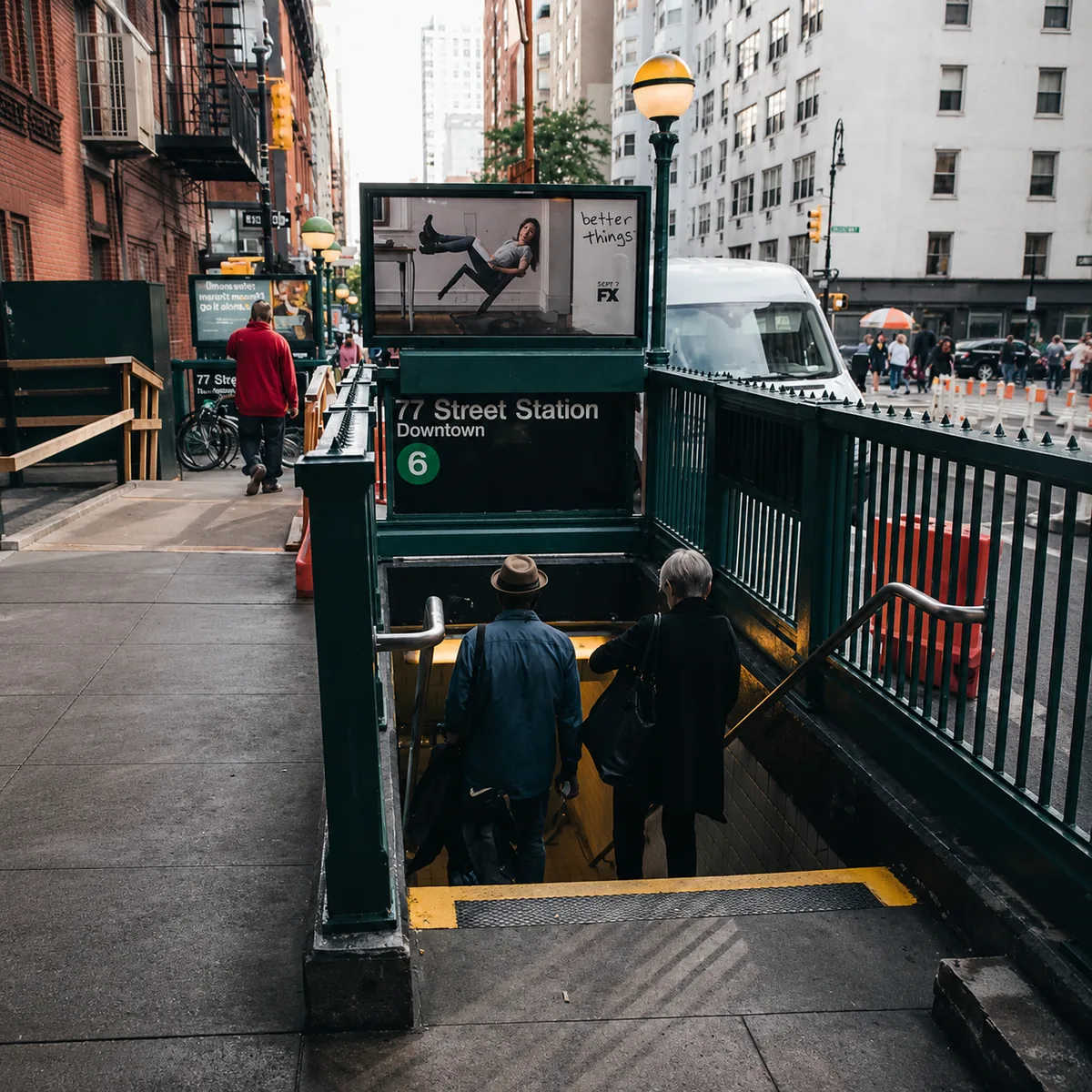
The system can seem intimidating at first, but it is simpler than it looks. On the subway and buses, you can pay by tapping a contactless card, phone, wearable or OMNY card on the reader; there is no need to download an app to use it.
MTA
A common mistake is switching cards or devices halfway through the week and losing out on possible accumulated benefits. The MTA says you should use the same card or device for transfers and to benefit from weekly fare caps.
MTA
Use the same card or device for transfers and weekly fare caps.
Thinking Times Square represents the whole city
Times Square is impressive the first time: giant screens, neon lights, costumed characters, noise, tourists staring upward as if the sky were made of advertisements. It is worth a short visit, especially at night. But spending too much time there can give you a poor impression of New York.
The city breathes better elsewhere: a tiny café in the West Village, a bookshop in Brooklyn, a morning at the Met, sunset from Brooklyn Heights, a walk along Hudson River Park. Times Square is spectacle; New York is much more than that.
Times Square is spectacle; New York is much more than that.
Eating only where tourists are lining up
New York can be a wonderful city for food, but it can also be expensive and disappointing if you keep falling into viral spots, central chains or restaurants chosen out of sheer tiredness. The city is full of cuisines from around the world, from dumplings to bagels, from ramen to neighborhood pizza, but you need to move a little away from the most obvious routes.
Avoid deciding every meal at the entrance to an attraction. Look for neighborhoods, markets, diners with character, local bakeries and restaurants where New Yorkers also eat. And remember that tipping is part of the service culture: failing to factor it in can turn an apparently reasonable bill into an uncomfortable surprise.
Avoid deciding every meal at the entrance to an attraction.
Ignoring basic safety without giving in to fear
New York should not be explored with paranoia, but not with naivety either. The official tourism office describes it as one of the safest large cities in the United States, while advising common sense, keeping an eye on your belongings and using licensed businesses, especially for services such as airport taxis or rentals.
New York City Tourism + Conventions
Do not accept unofficial rides when leaving the airport. Do not show all your cash in the street. Do not walk through unfamiliar areas late at night just because the map says your hotel is “twenty minutes away.” Safety in New York is usually a matter of judgment, not fear.
Safety in New York is usually a matter of judgment, not fear.
Visiting without thinking about the time of year
New York changes its skin with the seasons. In spring it can be bright and elegant; in summer, humid, intense and exhausting; in autumn, cinematic; in winter, beautiful on some days and harsh on others. The cold between buildings is not a metaphor: it bites. The heat of the subway in August is not easily forgotten either.
If you travel at Christmas, expect crowds and high prices. If you go in January or February, you will find a rawer city, perhaps cheaper, but less forgiving if you plan to walk for hours. The season will not ruin the trip, but it will change the kind of trip you have.
The season will not ruin the trip, but it will change the kind of trip you have.
Treating locals as if they were part of a postcard
How to interact better with New Yorkers
New Yorkers are not usually cold; they are usually in a hurry. There is an important difference. In New York, direct politeness is appreciated: ask clearly, step aside if you need to check your phone, do not block escalators or subway doors, ask for help without beating around the bush and say thank you without making a performance of it.
Do not stop in the middle of the sidewalk to work out your route. Do not take up the whole width of the pavement when walking in a group. Do not enter the subway before letting people off. Do not turn every interaction into a tourist scene. The city works because millions of people accept certain invisible rules of speed and space.
The good news is that many locals are more helpful than their reputation suggests. They will point you toward a subway line, an exit, a street. But do not expect a long conversation if they are on their way to work. New York can be kind; it just rarely stops to prove it.
In New York, direct politeness is appreciated.
Believing that more expensive always means better
In New York, you can pay a lot for mediocre views, forgettable cocktails and tiny rooms. You can also have a memorable moment with a coffee at dawn, a ferry ride, a walk across a bridge or a slice of pizza eaten standing up.
Money helps, but it does not guarantee emotion. Before booking observation decks, musicals, restaurants and sightseeing passes, ask yourself whether they fit the way you travel. Some passes are worth it if you plan to string together many attractions; if you prefer to walk and choose calmly, they may push you into rushing.
Money helps, but it does not guarantee emotion.
The biggest mistake: traveling to New York with an idea that is too rigid
New York will not always be comfortable. There will be noise, queues, high prices, construction work, confusing stations and days when the city seems far too full of itself. But there will also be unexpected light falling on the brick façades of the West Village, a saxophone underground, a view of the skyline from Brooklyn, a brief conversation in a deli, a night when everything feels possible.
It is worth it for curious, active travelers who can tolerate noise and are willing to walk a lot. It may disappoint anyone looking for calm, constant ease or orderly beauty. New York does not always caress; sometimes it shoves. But once you learn to move with it, even its rough edges become part of the memory.
Once you learn to move with it, even its rough edges become part of the memory.
C
DiscoverCars
Car rental
Compare prices and book your rental car at the best price.
Enjoy Christmas in New York with Santa Claus on a guided experience with photos and a hot drink. Check price, duration, accessibility and book on GetYourGuide.
From 134 EUR per personThe activity lasts approximately 1.5 hours.

 Activity on TourBookGo